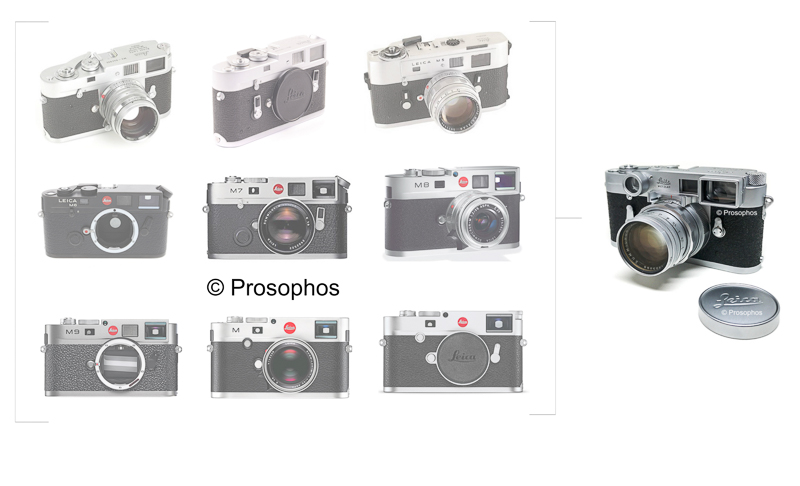
Yesterday, I had the pleasure of handling every single M rangefinder camera model Leica has ever manufactured (including a few limited edition examples of each).
And although I’ve previously worked with most of these cameras, I’ve never had the opportunity to handle all of them at the same time so that I could compare their build quality, viewfinders and shutters.
The one that remains my favourite is the Leica M3.
Many photographers have previously discussed why the M3 is regarded as perhaps the best M camera Leica ever made, so I won’t re-hash all of that here.
Others, it will come as no surprise, disagree with that assessment and have been quick to point out its faults. Even I recognize its not-too-insignificant shortcomings.
For example:
Do I wish the M3 had 35mm frame lines? Yes.
Do I wish the M3 could focus closer than 1 meter for most lenses? Of course.
Do I wish the M3 had a built-in light meter? Sure.
But, I know that the addition of each of these features ultimately takes away from something else. It essentially ruins the formula that makes the M3 the M3.
(Incidentally, the compromises inherent in every camera design decision is why a photographer who sets out to find the “perfect” camera is, in actuality, on a fool’s errand — and all of us have been guilty of playing the fool.)
Still, the sense of purpose and dependability that the M3 brings to the pursuit of photography seems unmatched by every other model.
I can tell you that its build quality really is second to none. Pick up an M3, and it truly does feel like a solid and singular block of matter. It’s an illusion of course, because the M3, like all subsequent M cameras, is made from a plethora of parts:
–
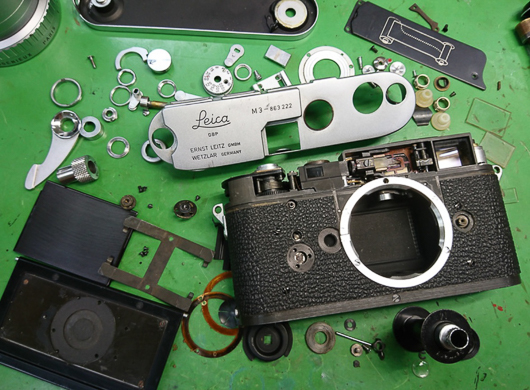
(↑ re-building of a Leica M3 by Kanto Camera)
–
But, in the M3, the decision process around which parts were chosen and how they were put together was done with the least number of compromises. It’s evident when you pick one up. Even the much-glorified modern film camera reincarnations of the M3, the Leica MP and M-A, feel somewhat tinny and hollow in comparison.
Besides build quality, the other attraction to the M3 for me is its clear viewfinder, which is the most resistant to flare and has the highest magnification of any M. These qualities are very helpful when composing and focusing. The view is also uncluttered. In comparing the M3 viewfinder to the one found in the digital M10, where bright and blinking LED frame lines compete with the subject for the photographer’s attention, I can’t help thinking that, somewhere along the way, Leica lost its focus, so to speak.
(But I know I am in the minority on this, since — more and more — blinking visual aids are the preferred feature set for many photographers.)
And, as much as I would love it for the M3 to have an internal light meter, I have to admit that, once again, the blinking lights in the M6, M7, and MP viewfinders seem to distract more than aid.
Am I being picky in writing all of the above? Yes, of course.
Could I go on, and on? Unfortunately, yes 🙂
But I will stop here. The truth is, all of the M cameras do an excellent job of getting out of the way of the photographer. For me, however, the M3 does it best.
—Peter.


















 Prosophos