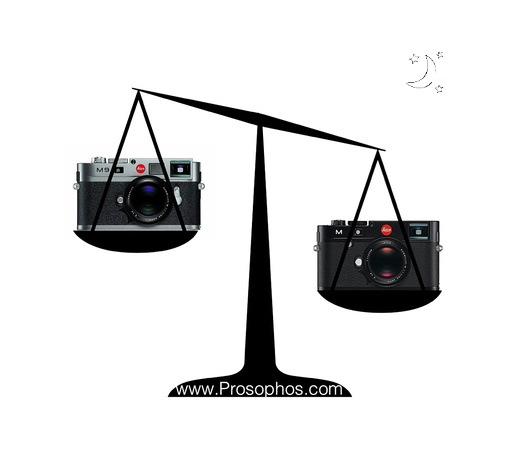
Q&A: Kerwin asks about the M9 in low light, M240.

Inspiration, Q&A, Teaching point

M9 in low light, M240

“Hi Peter,

I love your site and the pictures that you post.  They are a great inspiration for me to get better at being a photographer.  I follow your blog and have been very curious about the M240 and M9 debate, or the CMOS and CCD sensor battle.  I have an M9 and have been thinking about moving into the M240.  Mind you I have only been shooting Leica for about a year now.  But when I see your images and read about what you have to say about the CCD.  Then I don’t want to get the M240 anymore.  Part of the reason why I would like to get the M240 is to be able to use the higher ISO for when shooting at lower light situations.  Anyway, I’m still holding on to the M9.  Any tips on what to do when shooting in lower light with the M9?

Keep up the great work!

Cheers,
Kerwin”

–

Hello Kerwin,

First of all, thank you so much for your nice comments.

Now, to address your questions, which are all excellent…

Yes, I’ve always believed, and continue to believe, that CCD sensor cameras produce images at base ISO that are more pleasing than CMOS sensor cameras.  However, in low light, CCD sensors struggle relative to their CMOS counterparts.

The introduction of the Leica Monochrom did much to close the performance gap, but of course you’re limited to B&W photography when using this camera.

Quite simply then, if you wish to continue to photograph in low light situations using an M9, you need fast (aperture) lenses, like the Summilux (f/1.4) or even Noctilux (f/1 or f/0.95) lenses.  If your subjects are relatively still, then of course a steady hand and slow shutter speed are very useful (as are monopods and tripods, but most of us who shoot rangefinders do not make use of such additional equipment).

It’s also critical to expose properly with the M9 when shooting in dark environments, especially when employing high ISO.  This can be a problem, since I rarely feel comfortable shooting above ISO 1250 with this camera.  Others limit their maximum ISO to 640 and then “push” the exposure up during image post-processing.  I do this frequently.

I said above that your questions are excellent, which is very true.  It turns out, however, that your questions are timely too…

–

I have decided to purchase an M240.

–

I know I will be sacrificing low ISO image quality, in the form of the “crispness” I currently see in my images, but I am willing to give the M240 a try.

Why?

Most of the time, the light in Toronto is poor, as the winters here are long and dark.  Having a camera that can comfortably shoot above ISO 1250 has increasingly become a priority for me.

And, after selling off most of my equipment over the last few days, I’ve decided I don’t want a Nikon D800, or Sony A7/A7R, or an Olympus E-M1, or Fuji X-E2.

No folks, I still want a digital rangefinder (please see the previous post, Rangefinder Cameras)

And as far as digital rangefinders go, there’s still only one game in town.

—Peter.

Ongoing Poll: Should Leica bring back the CCD sensor?

Inspiration, Q&A, Teaching point

The longest running CCD poll :), asking whether a brand new CCD sensor should reappear in a future Leica M camera, is still running…

Why am I continuing this?

Because I love the rendering of CCD sensors!  The Leica M9 is like a portable digital mini-medium format camera.

At the very least, CCD sensors offer us photographers an alternative choice.

I’ve noticed a few notable individuals who were initially very enthusiastic about the Leica M240 (CMOS sensor camera) have now changed their tune and are subtly conceding that the M9 image quality at low ISO is superior.

So far, I have just over 400 votes…

—Peter.

–

Related posts:

Relaxed (Nikkor-NOCT meets M9).

Inspiration, Nikon, Nikon 58mm f/1.2 NOCT, Portrait, Q&A, Teaching point

I thought this might be a fun follow-up to yesterday’s post.

A few years ago, I attached the Nikkor-NOCT 58/1.2 to the Leica M9, via a Novoflex adapter, and took this image.

Focusing involved guessing, because of course the Nikkor-NOCT is not rangefinder coupled.

Relaxed

↑Leica M9 + Novoflex adapter + Nikkor-Noct 58/1.2 @ f/1.2.

–

Here is another test shot:

M9 + Nikkor-NOCT↑Leica M9 + Novoflex adapter + Nikkor-Noct 58/1.2 @ f/1.2.

–

As can be appreciated in the second image, one of the nice things about the Nikkor-NOCT is its near focus ability,

—Peter.

Nikon 58MM F/1.4G: The Nikkor-NOCT, reloaded.

Inspiration, Nikon, Nikon 58mm f/1.2 NOCT, Teaching point

58mm Noct vs. 1.4 Prosophos

Well, not exactly, as this new AF-S NIKKOR 58mm lens has a maximum aperture of f/1.4 (vs. f/1.2), but Nikon promises:

“The AF-S NIKKOR 58mm f/1.4G is a lens that makes the most of advanced optical design technologies… to achieve high reproduction capability of point light sources even at the maximum aperture, and natural depth of subjects utilizing smooth and beautiful bokeh characteristics. With shooting of distant night landscapes, the lens minimizes the sagittal coma flare…”

–

Sounds familiar, doesn’t it?  These were the coveted attributes of the Nikkor-NOCT.

Those of you who have been following this blog already know that the legendary Nikkor-NOCT was my favourite NIkon lens, and may very well be my favourite lens of all time:

–

The Pirate 2

The Pirate

Swing

–

Will the new lens be as impressive?

I hope so, given all the advances in lens design and manufacturing over the last several decades.  However, one thing I know for sure is that the new lens won’t have that silky-smooth manual focusing with which the old Nikkors were bestowed.

Either way, these are exciting times in photography.

Check out the specifications of the new AF-S NIKKOR 58mm f/1.4G here, and sample images here.

—Peter.

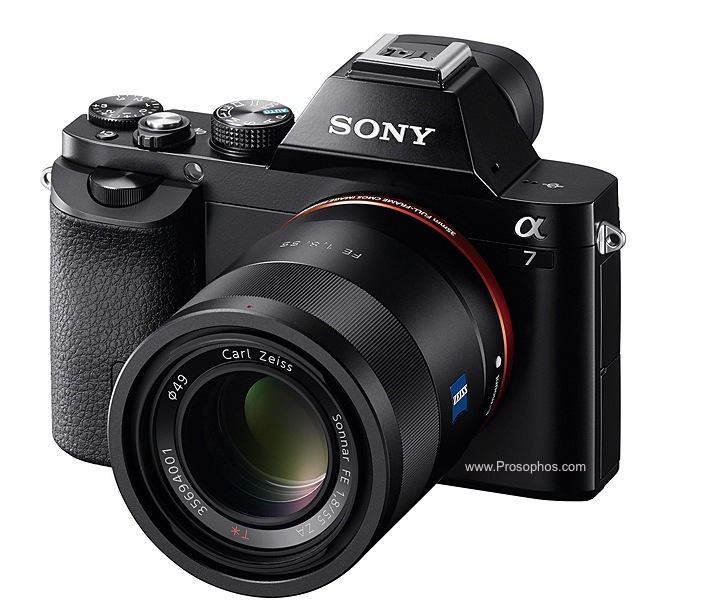
Sony A7 and A7R.

Inspiration, Q&A, Teaching point

Prosophos Sony A7

I once wrote:

The first manufacturer, other than Leica, who places a 24 x 36 sensor in a mirrorless interchangeable lens camera can count me in as a customer.  I have no doubt that at some point, somebody will do it.

However, the insanely loud shutter on the A7/A7R is a deal-breaker for me.  You can listen to it in this field test video (courtesy The Camera Store) at approximately 5:22 into the video.

The EVF is already dated too.

Too bad.

Still, you have to give Sony credit for shaking the industry.

—Peter.

Poll update: CCD-based Leica M?

Inspiration, Q&A, Teaching point

Poll - Leica back to CCD? Prosophos

–

So far, after 125 votes, I’m surprised to see the overwhelming majority of you do want a CCD sensor in a future Leica M.

(By the way, you may still vote.)

Most of the internet fora discussions would have you believe that opinion is evenly split, or perhaps favours the new Leica M(240) and its CMOS sensor.

I know that the sample size of this poll is extremely small, and there may be selection bias at play (i.e., those who follow this blog may be biased towards favouring CCD sensors) — which makes the results tenuous at best — but the results are intriguing.

Perhaps things will equalize as more votes are cast.

—Peter.

Poll: Should Leica bring back the CCD sensor?

Inspiration, Q&A, Teaching point

CCD Poll - Prosophos

As most of you know, I’ve been very vocal about my preference for CCD vs. CMOS sensors…

…but it looks like the Leica M9/M-E and Monochrom are the end-of-the-line models for 36 x 24mm CCD sensor technology.

Nonetheless, I thought it would be fun to conduct a poll about this, here on Prosophos.com.

Essentially, I’d like to know whether YOU would like to see Leica bring back a new CCD sensor in a future M camera, optimized with whatever current technology exists.

Please vote and voice your opinion, but remember this is just for fun.

—Peter.

–

Rangefinder cameras.

2013, Favourite, Inspiration, Leica 50mm Summilux ASPH f/1.4, Leica M9(P)/M-E (CCD Lives!), Portrait, Teaching point

Rangefinder

Life is too short, to have never experienced a rangefinder camera.

If you’re a photography enthusiast, and you’ve never had the pleasure, do yourself a favour and shoot with a rangefinder (Leica, Zeiss, Mamiya, Voigtländer, Contax, Nikon, Epson, Fuji, Yashica, or whatever).

It will change you.

—Peter.

Voigtlander Color Skopar F2.5/35mm Pancake II.

Inspiration, Q&A, Teaching point, Voigtländer 35mm f/2.5 Color Skopar Pancake II, Voigtländer 40mm f/1.4 Nokton

Voigtlander Color Skopar F2.5:35mm P II

Introducing the Voigtländer Color Skopar F2.5/35mm P II.

I’ve been experimenting with this lens for the last 24 hrs and, so far, I like it.  Small, sharp, smooth.  Its strength is in daylight shooting, not just because it is limited to a maximum aperture of f/2.5, but because of the way it holds highlights.

Images will follow — maybe in a few days — so you can judge for yourself.

Voigtländer always delivers great lenses, so I shouldn’t be surprised at the results.

In the meantime, feel free to re-visit my report on one of my favourite lenses, the Voigtländer Nokton 40mm f/1.4.

—Peter.

Socrates & Eminem.

Inspiration, Teaching point

“Well I am certainly wiser than this man. It is only too likely that neither of us has any knowledge to boast of; but he thinks that he knows something which he does not know, whereas I am quite conscious of my ignorance. At any rate it seems that I am wiser than he is to this small extent, that I do not think that I know what I do not know.”

—Socrates  (470 – 399 BC)

–

“At least I know that I don’t know

Question is are you bozos smart enough to feel stupid…”

—Eminem, Berzerk (2013)

The most popular post this month on Prosophos.com?

Inspiration, Q&A, Teaching point

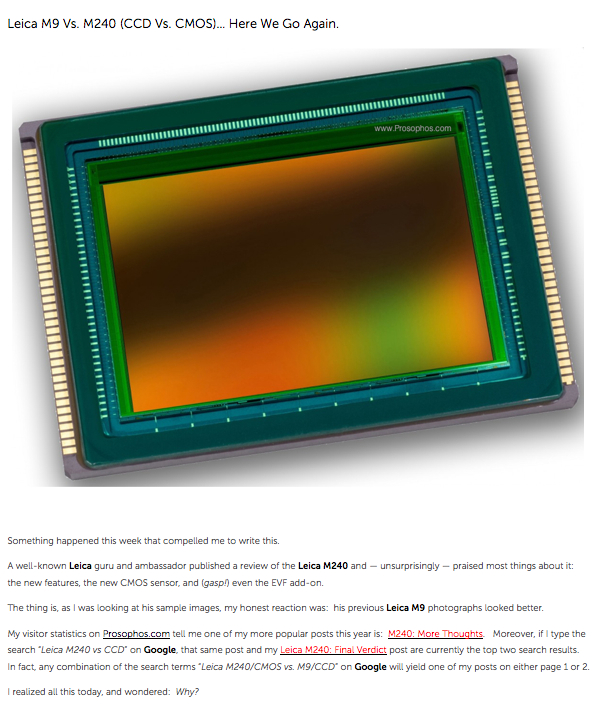
Leica M9 vs. M240 (CCD vs. CMOS)

–

I was surprised to see that above is still the most popular post on Prosophos.com, given I posted it three months ago.

Leica M9 vs. M240

Yes my friends, I guess the CCD vs. CMOS sensor debate rages on… for many.

Not for me though.

—Peter.

–

_______

Related posts:

M240: More Thoughts

Leica M240: Final Verdict

Leica M9 sharpness vs. Sony RX1R, Nikon D800E, Fuji X100s

645.

Inspiration, Q&A, Teaching point

Recently, I asked the question:  How large a print can you make from a Leica M9 file?

For my purposes (portraiture and simple element scenes), the answer turns out to be 36 x 24 inches:

–

36 x 24 comparison

–

I thought about this some more, and realized that it would be interesting to see how much of a magnification over the Leica M9 sensor those prints above represent.  If you want to skip the math below, the answer turns out to be 645!

Here’s the math:

The Leica contains a so-called “full frame” sensor that is exactly 36 x 24 mm in size (that’s where the 36 x 24 comes from).

The area of this sensor

= 36 x 24 mm

= 864 mm2

 –

The prints I made were 36 x 24 inches.

In the equivalent (metric) mm, this translates to

= 914 x 609.6 mm

=557, 174.4 mm2

 –

The magnification of print-over-sensor area, therefore

= 557,174.4/864

= 645

–

This is remarkable when you think about it.  The digital sensor (about the size of a stamp — remember those?) produces an image which is then magnified 645 times to produce the prints you see above.

Proportionally, this is what is going on:

645 Times

All of the above underscores the importance of technique, lens quality, etc., when photographing with the aim of producing large prints: any “error” will be magnified 645 times!

Of course, you always have the option of turning to the much larger and more forgiving medium format sensors, but that’s another story…

—Peter.

36 x 24.

Inspiration, Leica 24mm Summilux ASPH f/1.4, Leica 50mm Noctilux f/0.95, Portrait, Q&A, Teaching point

How large a print can you make from an M9 file?

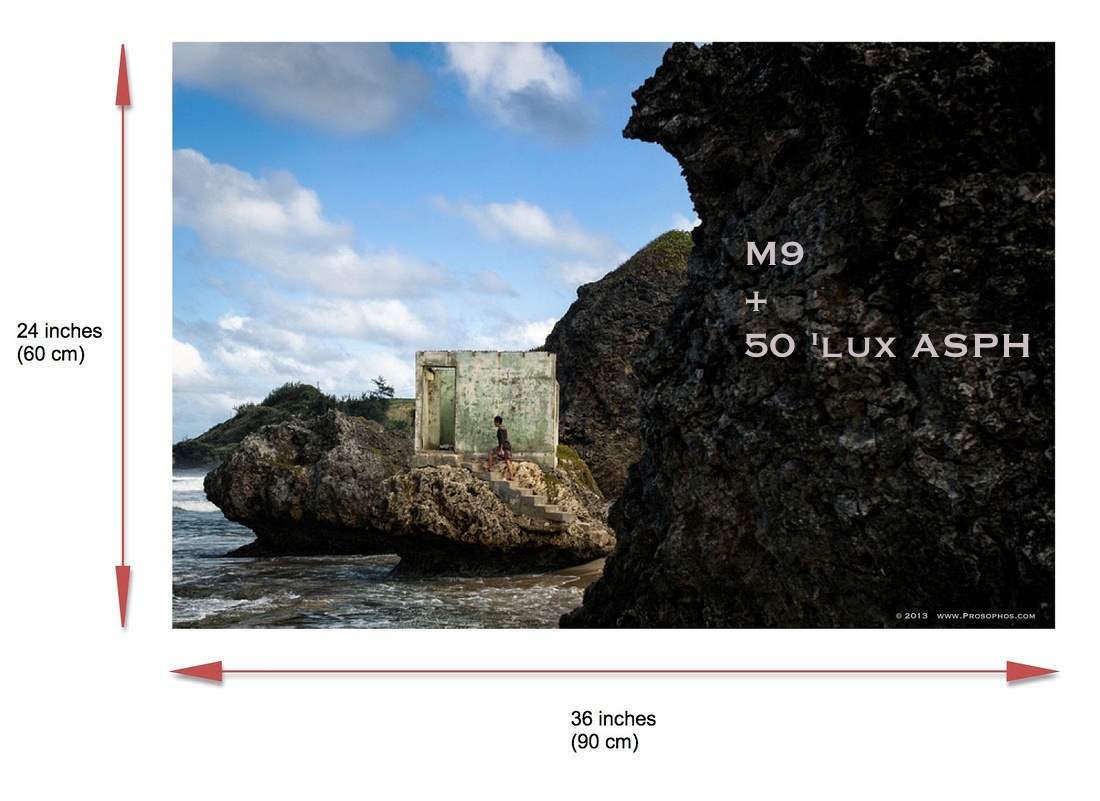
Well, the largest I’ve printed for clients is 36 x 24 inches:

24 x 36 M9 50 Summilux

Even at this large a size, the detail from the M9 and the 50mm Summilux combo used to create the image above is impressive.

However, yesterday I tried doing this for the first time with two other lenses:  the 24mm Summilux (f/1.4) and and the 50mm Noctilux (f/0.95).  Truth be told, I wasn’t expecting anything near as good as what I get from the technically brilliant 50 Summilux ASPH.

We’ll I’m happy to report that I was wrong.  They not only did well, they did exceptionally well — I was astounded to see how much detail the 24 Summilux and 50 Noctilux produce at their widest apertures.

But in the age of phone and tablet image viewing, most people will never encounter an actual print, let alone a 36 x 24 print.  So what does 36 x 24 actually look like?  I thought I’d show you with a little demonstration:

(please click on the image to view at MAXIMUM size and detail)

24 x 36 size demo

—Peter.

The Sony RX1R… is gone.

Inspiration, Q&A, Sony RX1R, Teaching point

Prosophos Sony RX1R

In summary:

The Sony RX1R has great image quality, but is not so great at capturing the “decisive” moment.  Too slow.  Too many button presses in manual mode.  Too much of a clunky computer, not enough of a camera.

If you’re into static scenes, posed shots, or letting your camera do the work for you in auto mode however, it just might be your ticket.

Although I created many images with the RX1R, I’m only posting one or two more.

—Peter.

Compared to the Leica M9, the Sony RX1R…

Inspiration, Q&A, Sony RX1R, Teaching point

…feels like a toy.

…is not an extension of my hands and eyes.

…is slower.

…is equipped with a Zeiss lens-CMOS sensor combination that produces files that are not as sharp (or microcontrast-y) as the M9 with top Leica glass  (the dpreview tests I posted last week were correct).

…is equipped with a Zeiss lens that cannot handle back-lighting as well as modern Leica lenses.

On the positive side, the RX1R:

…is lighter and smaller.

…produces nicer B&W conversions.

…has more dynamic range.

…is equipped with a Zeiss lens that produces smoother bokeh vs. the Leica 35mm Summicron (or Summilux FLE).

…is equipped with a Zeiss lens that focuses closer than the Leica lens equivalents.

.

.

.

These are my initial thoughts.

—Peter.

Leica M9 sharpness vs. Sony RX1R, Nikon D800E, Fuji X100s.

Inspiration, Q&A, Teaching point

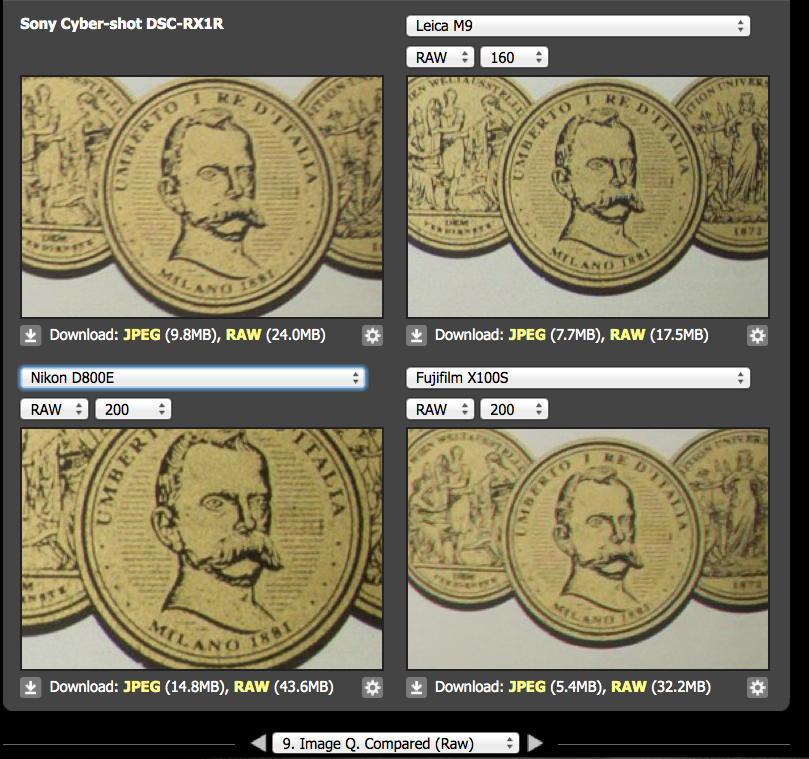
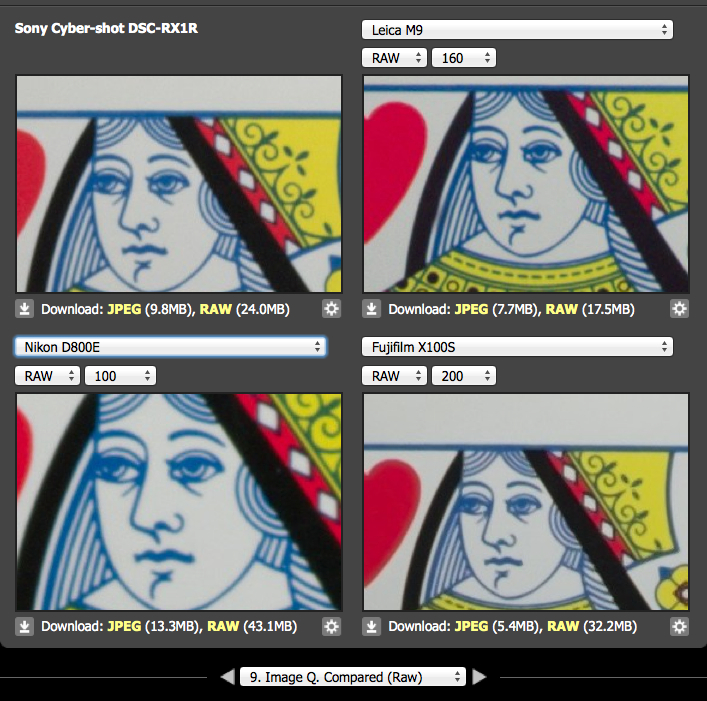
The website Dpreview, the “original” internet hangout for camera geeks and enthusiasts, has a useful studio scene comparison tool that allows one to pit camera against camera.   I was using it today to compare Sony‘s new RX1R (the new AA filter-less version of the RX1) vs. the old trusty Leica M9.  For fun, I also included two current cameras that have generated much enthusiast interest: the Fuji X100s and the Nikon D800E (admittedly, the Fuji X100s is the only camera of the bunch that doesn’t use a full frame sensor, so it’s sort of the oddball in this sensor grouping but, to me, it’s relevant as a portable and formidable photographic tool).

Here is the overall studio scene, as seen on Dpreview:

Prosophos - dpreview overview

–

And here are the (left) side 100% crops of the above scene, from each camera, focusing on the label of the Martini bottle (see the red arrow above):

(please click on this image to view at MAXIMUM size and sharpness)

Prosophos - dpreview M9 againts latest cameras

–

(Note: the crops above vary in size, depending on the megapixel count of each sensor.)

See anything, possibly unexpected here, regarding sharpness?

Finally, here are the centre 100% crops , focusing on the Queen of Hearts card in the original scene:

(please click on this image to view at MAXIMUM size and sharpness)

Prosophos - dpreview central 100%

Using the Dpreview comparison tool, one can obviously pick and choose other portions of the scene to make comparisons about sharpness, texture rendering, etc.  I’ve chosen two areas that I believe are representative of lens sharpness performance (corner vs. central) with respect to these cameras (the feathers in the far right of the scene are also worth checking out).

—Peter.

—

If you haven’t already done so, please consider signing my open letter to Leica.

Prosophos Open Letter to Leica

___

Related posts: