Aaron just posted this comment (see below) under the the October 1 post, but I believe his thoughts warrant a standalone post.
Thank you,
—Peter.
–
Aaron C Greenman writes:

Aaron just posted this comment (see below) under the the October 1 post, but I believe his thoughts warrant a standalone post.
Thank you,
—Peter.
–
Aaron C Greenman writes:
Today, Aaron shares his thoughts (as well as a fine image) after his recent extensive use of the Hasselblad X1D.
You can find more of Mr. Greenman‘s work at: acuitycolorgrain
Thank you Aaron for your contribution!
—Peter.
– – – – – –
ACG writes:
–

↑Image © Aaron C Greenman.
People sometimes ask me why I limit the size of my posted images.
The main reason is: theft.
Here is the latest example:
–

The above site did not ask me for permission to use my image.
I have written to them to remove it immediately.
—Peter.
There’s a follow-up article by my friend Ashwin Rao on Steve Huff’s site today discussing his long term experience using the Leica M10. As would be expected from Mr. Rao, it’s an interesting read but what caught my attention is how much of the article is devoted to comparing the M10 to the M9.
That’s pretty remarkable considering the M9 is now two generations behind… but it’s also something that doesn’t surprise those of us who still appreciate M9 cameras.
On a related note, there’s even an entire thread on the Leica User’s Forum titled What I miss from my M9 in my M10.
(By the way Ashwin, I agree with you that the M10 has regained some of that image quality “pop” that went missing from the M240).
Related reading (particularly the discussion in the comments) from 2013:
The M240 image quality is a step down from the M9.
—Peter.

Interestingly, I don’t like the bokeh from the Leica 50mm Summicron APO.
I mean, everybody raves about it. And admittedly when I examine it in photographs (magnified to reveal detail) it looks quite neutral and uniform. So it should look good overall. But when I view the image in its entirety, I intensely dislike the out of focus portions. The elements within the bokeh are too “structured”. Perhaps the out-of-focus areas — similar to the in-focus areas — are somehow “sharper”. Though neutral, the net effect is more… visible.
(Perhaps, though, people have applied too much structure during post-processing. That’s the only variable I can’t tease apart when viewing others’ images.)
My preferred 50?
Still the Leica 50 Summilux ASPH. I continue to believe that it achieves the best balance between size and performance vs. any other 50 in the full frame format. There are sharper 50mm lenses, there are more corrected 50mm lenses, and there are faster 50mm lenses, but none of them achieve the over-all balance of the Summilux.
—Peter.
This is essential for capturing the decisive moment.
The classic (film) rangefinders have extremely brief shutter lag times (msec):
Leica M3 16
Leica M7 12
Compare this to the following digital rangefinders, which have much longer shutter lags (msec):
Leica M8 80
Leica M9 80
(source: Wikipedia)
My preference would be to have the OVF retained.
If the decision is made to move to an EVF (to improve focusing accuracy, avoid the rangefinder drift that plagues current rangefinders, etc.) the following criteria should be met:
Reliability is a priority. This should be the minimum expectation for a luxury/professional camera.
Moisture sealing. The expectation is not that it should be as impervious to the elements as a professional DSLR, because that would add too much bulk/weight, but that it should be able to withstand water spills, light rain, etc.).
Excellent battery life. With current technology, this may necessitate a slight increase in the size of the camera thickness (for example thicker than the Leica M10) to accommodate a larger battery. However, this is an acceptable trade-off given the benefit of longer battery life. Also it is unrealistic to expect film-era camera body thickness in a digital M when modern lenses themselves have also grown in size and weight as compared to their film era progenitors. The camera body-lens pairing should balance nicely to avoid grip fatigue, etc.
Current frame rates are acceptable for a rangefinder.
However, shorter card-writing times and larger buffers are always welcomed. This too may require a slightly thicker M to enable adequate heat dissipation.
The ability to review photos quickly, at 100% magnification (with the touch of one button) to be able to quickly verify focus, and to maintain 100% view while scrolling through a sequence of images, etc would be desirable.
A large (medium format) digital sensor rangefinder would be desired by many current M photographers.
This is best envisioned as a modern day Mamiya 7 but with a digital sensor.
The rangefinder format would allow for minimal camera size (width).
Together with manual focusing lenses built to the same quality/performance as M lenses this would offer an extremely desirable level of image quality.
However, it must be conceded that pricing for such a system would potentially place it out of the financial reach of a significant proportion of photographers/consumers.
In that case, a fixed-lens version (along the lines of the Leica Q but with the aforementioned medium format sensor) may be a more viable (attractively-priced) option. A design of this type (fixed lens matched to the sensor) would also potentially allow for a smaller lens size, since custom software corrections for lens design compromises would be possible (again, akin to the Leica Q).
—Peter.
I had the pleasure of using the Leica 28mm Summilux ASPH today.
The verdict: this lens is okay.
Technical notes:
—Peter.
–



↑Leica M9 (CCD Lives! – Prosophos Open Letter to Leica) + Leica 28mm Summilux ASPH.
As I have been waiting for my Leica M3 to return from its total tear-down and subsequent re-build, I’ve been thinking that perhaps a new neck strap for it would be in order; something more befitting a 60 year old camera than the stock Leica nylon/rubber strap that I have been using for all of my rangefinders over the last few years.
(In the past, I’ve tried products from all over the world from all the various well-known strap manufacturers — and I mean all of the well-known ones — and for one reason or other I have always found them lacking.)
Recently, however, I stumbled upon the website of Mr. Harry Benz.
“Yet another hand-made strap purporting to be different than the competition“, I thought.
I was prepared to discard Mr. Benz completely because, frankly, I had never heard of him before. Yet as I read through the description of how Harry makes his straps, I realized that he was indeed creating something unique. He even uses a different leather — not cowhide (I’ll let you discover for yourself on his site what it is).
Given the level of craftsmanship and passion for detail, I expected to find Harry located in some venerable city known for its artisanal leather industry. Imagine my surprise when I instead discovered he was living in my very own city of Toronto, Canada.
After a few emails back and forth I had placed a custom order specifying the colour, design, and length of my strap. We also arranged to meet in person for pick-up and payment once the strap was ready.
Well today I had the pleasure of meeting Mr. Benz, and I wasn’t disappointed in either the man or his product. Although I don’t yet know how well my new neck strap will endure over time, I have a sense it will outlast me.
In the meantime, I can marvel at the beauty of it.
—Peter.
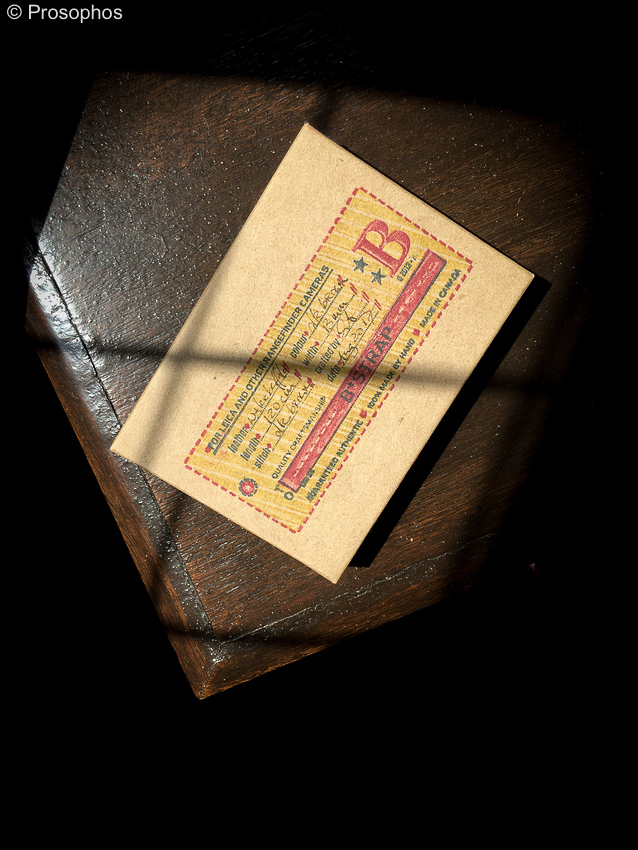

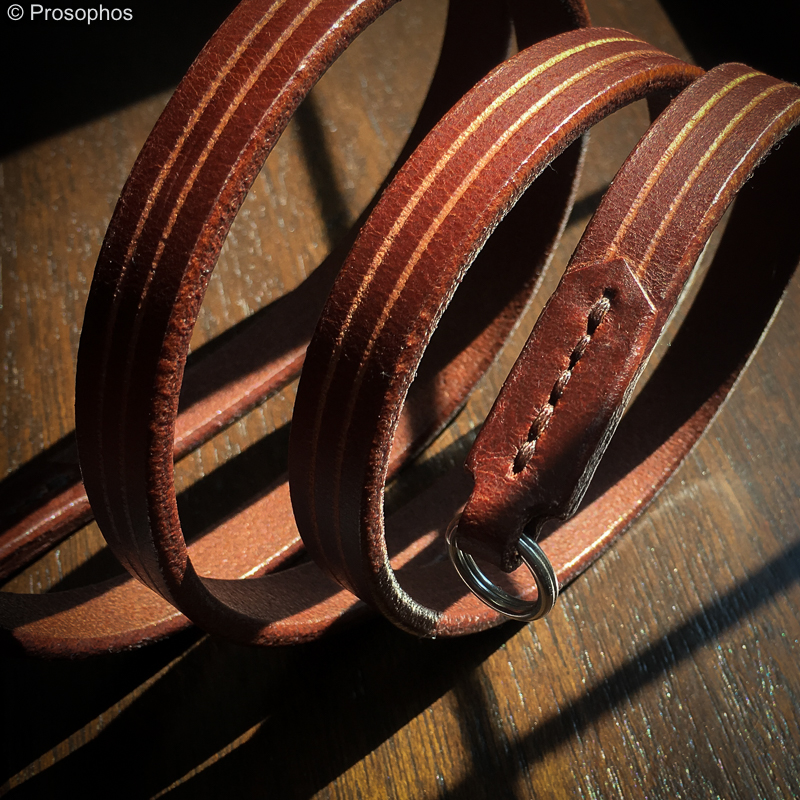
All photos above taken with an iPhone and © Prosophos.
I violated one of the photography rules here by having a blurry foreground element (the cup) as I instead chose to focus on the plate (specifically the De Mello “faces”).
I think it works, hopefully you do too.
—Peter.
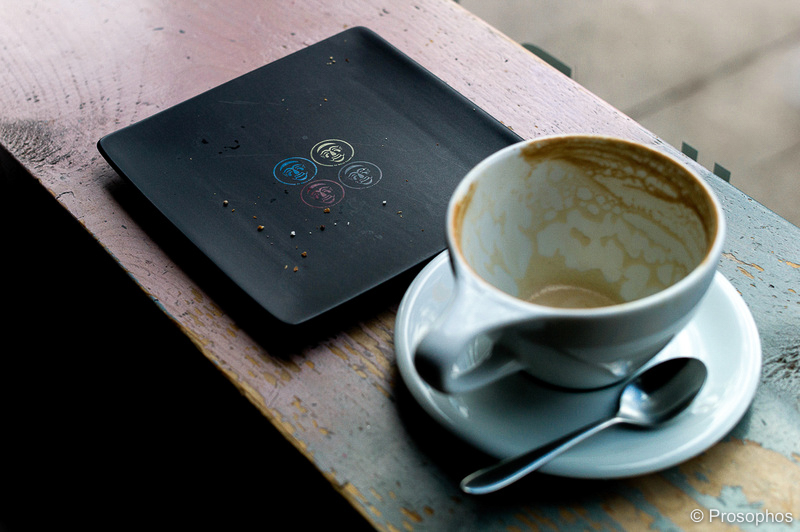
↑Leica M9 (CCD Lives! – Prosophos Open Letter to Leica) + Leica 50mm Summilux ASPH.
(The original post is here: Photography truths/rules I’ve learned over the years.)
–
—Peter.

Nikon quietly released a firmware update for their D500 camera on July 11th that officially was supposed to fix only one issue:
“Fixed an issue that resulted in unreliable connections between the camera and the iOS 10.2 version of the SnapBridge app.”
Despite the fact that I don’t use the “SnapBridge” app, last week I went ahead and downloaded and installed the new firmware.
The result?
I’m happy to report that the well known D500 battery drain (where an unused battery will lose a significant amount of its charge with each passing day while sitting idle in the camera) is now fixed! Every day since the update I’ve checked the battery status and the charge continues to read “100%”. This applies equally to the battery in my accessory grip.
Prior to this firmware update I was losing 5 – 7% of battery charge per day.
Bravo Nikon!
(Please pass this information on to anyone you know who owns a Nikon D500.)
—Peter.
Digital photography records how things looked,
film photography records how things will be remembered.
—Peter.
This is the best Nikon DSLR camera I’ve ever used.
(I’ve previously owned and extensively used the Nikon D70, D200, D40, D3, D3S, D800E, Df, and D810.)
I never thought I’d go back to a crop sensor camera, but there you go.
—Peter.
Nikon has just announced the Nikon 28mm f/1.4E ED lens.
—Peter.


Years ago, Nikon discontinued the Super Coolscan 9000 ED.
As of 2017, no one else has managed to produce a comparable product (the Hasselblad Flextight scanners don’t really count because they play in another league with respect to price).
In the past, I’ve been reasonably satisfied with the Plustek 120, but I know its performance lags behind the old Nikon and something about its operation screams “beta product”.
Perhaps Plustek, you can step in and help, please? I really want to support you for continuing to make film scanners, but I’m looking for something a notch above your current line-up.
—Peter.
Test shot #9 from my 1957 Leica M3 DS.
Along with my subject, I’m pensive too, because I’m sending this camera for a CLA (the shutter speeds are clearly off… this image was underexposed by two stops and I had to “push” it in LR — hence the heavy grain).
And so now I’m back to contemplating the Ship of Theseus because I wonder:
Will my M3 be the same camera when it returns? Will it continue to give me the sort of images I’ve seen from this first roll of film?
I don’t know, of course. But I’ll keep you posted.
—Peter.
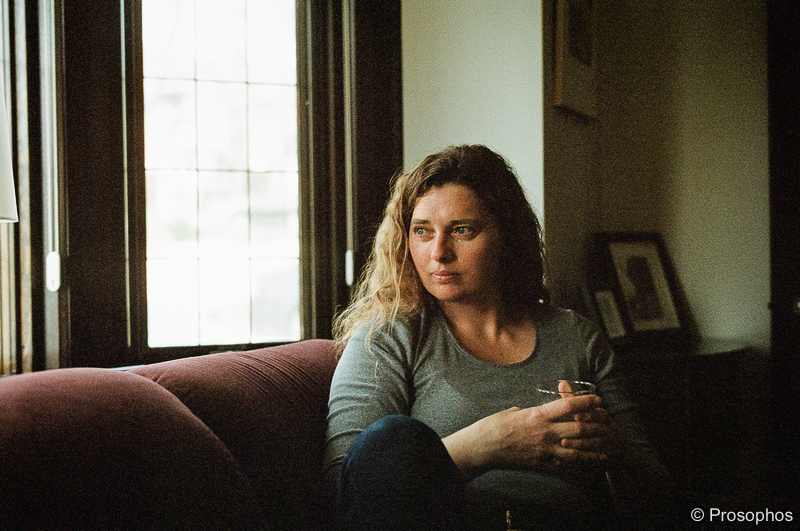
↑Leica M3, 50mm Summilux ASPH @ f/1.4, and Kodak Portra 800.
Test shot #1 from my 1957 Leica M3 DS.
I think the shutter speeds are off as most of the images in this first roll of film appear underexposed. Yet some look fine, so I’m at a loss.
I’m using Kodak Portra 800 here, which is more grainy than Portra 400, but I have a nagging feeling…
Anyway, I’ll take a grainy film image like this over the most polished digital equivalent any day.
Something more real about it.
—Peter.
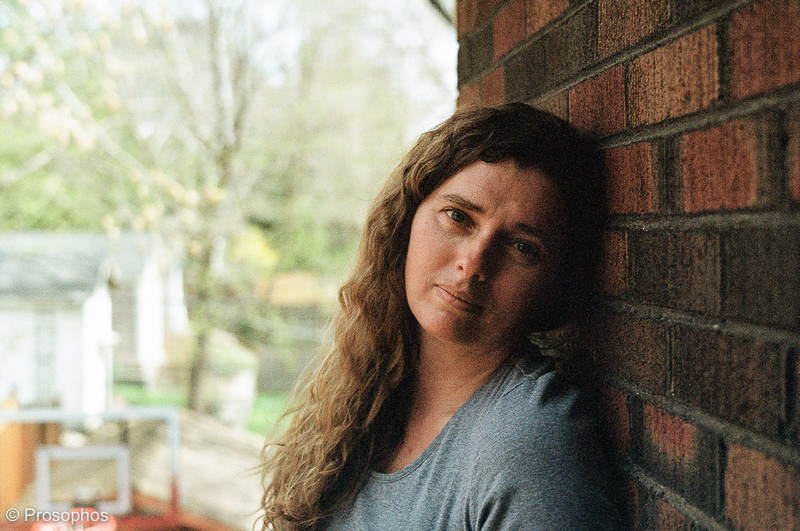
↑Leica M3, 50mm Summilux ASPH @ f/1.4, and Kodak Portra 800.

The Leica M3 was manufactured between 1954 and 1967.
Many collectors favour M3s with high serial numbers (1 000 0000 and up), or — at the other end of the spectrum — the first 1 000 ones made (with serial numbers 700 XXX). The first group are valued because they are thought to represent “perfected” late production examples, but as you will see below, that is a matter of perspective. The second group are coveted because, well… they were the first ones produced.
As a photographer however, my favourite M3s are the ones from the year 1957 (specifically the subset with serial numbers between 854 00 – 858 000) because they combine the best features of both early and late M3 bodies.
Specifically, the qualities of 1957 M3s that I value are:
Double stroke (DS) film advance levers with shorter arms. The shorter arms allow you to advance the film while holding the camera with one hand.
Modern shutter speeds (earlier models have the less-convenient older speeds: 1, 1/2, 1/5, 1/10, 1/25, 1/50, 1/100, 1/200…).
Silent return on the film advance lever (later models produce a ratcheting sound when returning).
Buddha (aka “Rabbit Ear”)-style lugs riveted (not screwed) to camera — no loosening or spinning of lugs.
Back door pin that allows it to securely click shut, preventing the door from inadvertently flapping open when changeing film (only available in cameras with serial numbers between 854 000 – 858 000).
Frame selector preview lever, which was not present in earlier models.
Double glass-reinforced eyepiece (later models have a single layer only).
—Peter.
 Prosophos