Poll update: CCD-based Leica M?

Inspiration, Q&A, Teaching point

Poll - Leica back to CCD? Prosophos

So far, after 125 votes, I’m surprised to see the overwhelming majority of you do want a CCD sensor in a future Leica M.

(By the way, you may still vote.)

Most of the internet fora discussions would have you believe that opinion is evenly split, or perhaps favours the new Leica M(240) and its CMOS sensor.

I know that the sample size of this poll is extremely small, and there may be selection bias at play (i.e., those who follow this blog may be biased towards favouring CCD sensors) — which makes the results tenuous at best — but the results are intriguing.

Perhaps things will equalize as more votes are cast.

—Peter.

Poll: Should Leica bring back the CCD sensor?

Inspiration, Q&A, Teaching point

CCD Poll - Prosophos

As most of you know, I’ve been very vocal about my preference for CCD vs. CMOS sensors…

…but it looks like the Leica M9/M-E and Monochrom are the end-of-the-line models for 36 x 24mm CCD sensor technology.

Nonetheless, I thought it would be fun to conduct a poll about this, here on Prosophos.com.

Essentially, I’d like to know whether YOU would like to see Leica bring back a new CCD sensor in a future M camera, optimized with whatever current technology exists.

Please vote and voice your opinion, but remember this is just for fun.

—Peter.

Rangefinder cameras.

2013, Favourite, Inspiration, Leica 50mm Summilux ASPH f/1.4, Leica M9(P)/M-E (CCD Lives!), Portrait, Teaching point

Rangefinder

Life is too short, to have never experienced a rangefinder camera.

If you’re a photography enthusiast, and you’ve never had the pleasure, do yourself a favour and shoot with a rangefinder (Leica, Zeiss, Mamiya, Voigtländer, Contax, Nikon, Epson, Fuji, Yashica, or whatever).

It will change you.

—Peter.

Voigtlander Color Skopar F2.5/35mm Pancake II.

Inspiration, Q&A, Teaching point, Voigtländer 35mm f/2.5 Color Skopar Pancake II, Voigtländer 40mm f/1.4 Nokton

Voigtlander Color Skopar F2.5:35mm P II

Introducing the Voigtländer Color Skopar F2.5/35mm P II.

I’ve been experimenting with this lens for the last 24 hrs and, so far, I like it.  Small, sharp, smooth.  Its strength is in daylight shooting, not just because it is limited to a maximum aperture of f/2.5, but because of the way it holds highlights.

Images will follow — maybe in a few days — so you can judge for yourself.

Voigtländer always delivers great lenses, so I shouldn’t be surprised at the results.

In the meantime, feel free to re-visit my report on one of my favourite lenses, the Voigtländer Nokton 40mm f/1.4.

—Peter.

Socrates & Eminem.

Inspiration, Teaching point

“Well I am certainly wiser than this man. It is only too likely that neither of us has any knowledge to boast of; but he thinks that he knows something which he does not know, whereas I am quite conscious of my ignorance. At any rate it seems that I am wiser than he is to this small extent, that I do not think that I know what I do not know.”

—Socrates  (470 – 399 BC)

“At least I know that I don’t know

Question is are you bozos smart enough to feel stupid…”

—Eminem, Berzerk (2013)

The most popular post this month on Prosophos.com?

Inspiration, Q&A, Teaching point

Leica M9 vs. M240 (CCD vs. CMOS)

I was surprised to see that above is still the most popular post on Prosophos.com, given I posted it three months ago.

Leica M9 vs. M240

Yes my friends, I guess the CCD vs. CMOS sensor debate rages on… for many.

Not for me though.

—Peter.

_______

Related posts:

M240: More Thoughts

Leica M240: Final Verdict

Leica M9 sharpness vs. Sony RX1R, Nikon D800E, Fuji X100s

645.

Inspiration, Q&A, Teaching point

Recently, I asked the question:  How large a print can you make from a Leica M9 file?

For my purposes (portraiture and simple element scenes), the answer turns out to be 36 x 24 inches:

36 x 24 comparison

I thought about this some more, and realized that it would be interesting to see how much of a magnification over the Leica M9 sensor those prints above represent.  If you want to skip the math below, the answer turns out to be 645!

Here’s the math:

The Leica contains a so-called “full frame” sensor that is exactly 36 x 24 mm in size (that’s where the 36 x 24 comes from).

The area of this sensor

= 36 x 24 mm

= 864 mm2

 –

The prints I made were 36 x 24 inches.

In the equivalent (metric) mm, this translates to

= 914 x 609.6 mm

=557, 174.4 mm2

 –

The magnification of print-over-sensor area, therefore

= 557,174.4/864

= 645

This is remarkable when you think about it.  The digital sensor (about the size of a stamp — remember those?) produces an image which is then magnified 645 times to produce the prints you see above.

Proportionally, this is what is going on:

645 Times

All of the above underscores the importance of technique, lens quality, etc., when photographing with the aim of producing large prints: any “error” will be magnified 645 times!

Of course, you always have the option of turning to the much larger and more forgiving medium format sensors, but that’s another story…

—Peter.

36 x 24.

Inspiration, Leica 24mm Summilux ASPH f/1.4, Leica 50mm Noctilux f/0.95, Portrait, Q&A, Teaching point

How large a print can you make from an M9 file?

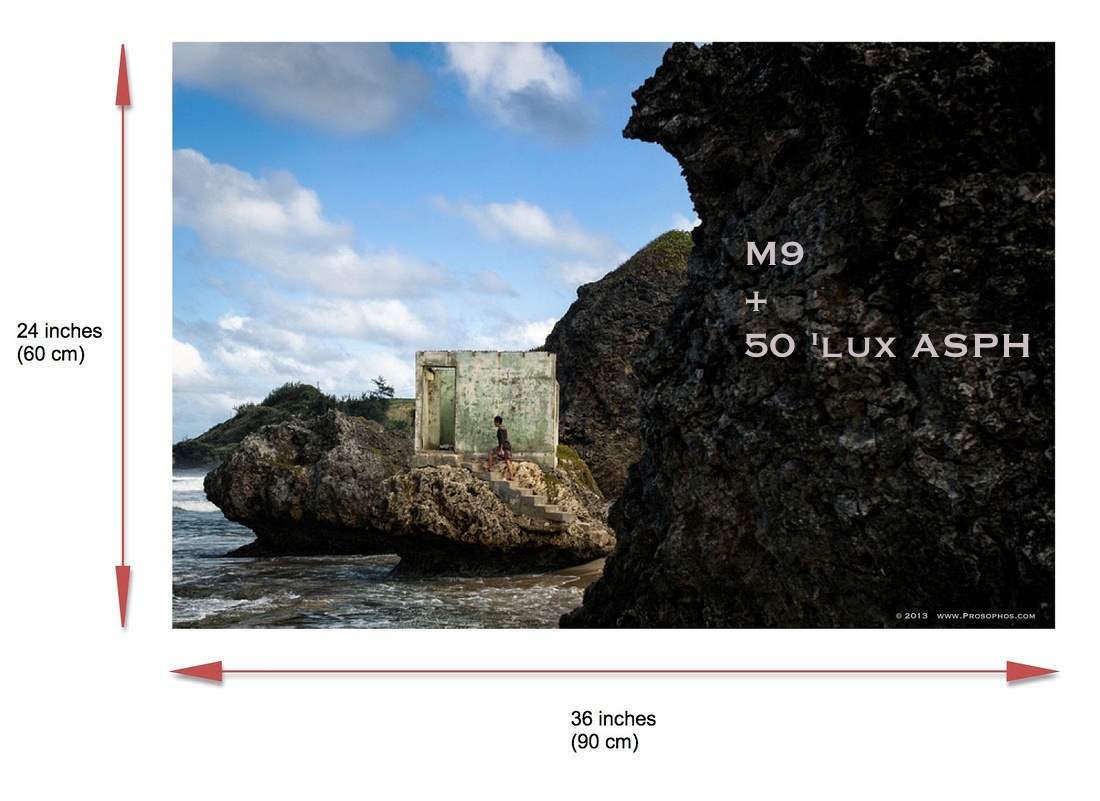
Well, the largest I’ve printed for clients is 36 x 24 inches:

24 x 36 M9 50 Summilux

Even at this large a size, the detail from the M9 and the 50mm Summilux combo used to create the image above is impressive.

However, yesterday I tried doing this for the first time with two other lenses:  the 24mm Summilux (f/1.4) and and the 50mm Noctilux (f/0.95).  Truth be told, I wasn’t expecting anything near as good as what I get from the technically brilliant 50 Summilux ASPH.

We’ll I’m happy to report that I was wrong.  They not only did well, they did exceptionally well — I was astounded to see how much detail the 24 Summilux and 50 Noctilux produce at their widest apertures.

But in the age of phone and tablet image viewing, most people will never encounter an actual print, let alone a 36 x 24 print.  So what does 36 x 24 actually look like?  I thought I’d show you with a little demonstration:

(please click on the image to view at MAXIMUM size and detail)

24 x 36 size demo

—Peter.

The Sony RX1R… is gone.

Inspiration, Q&A, Sony RX1R, Teaching point

Prosophos Sony RX1R

In summary:

The Sony RX1R has great image quality, but is not so great at capturing the “decisive” moment.  Too slow.  Too many button presses in manual mode.  Too much of a clunky computer, not enough of a camera.

If you’re into static scenes, posed shots, or letting your camera do the work for you in auto mode however, it just might be your ticket.

Although I created many images with the RX1R, I’m only posting one or two more.

—Peter.

Compared to the Leica M9, the Sony RX1R…

Inspiration, Q&A, Sony RX1R, Teaching point

…feels like a toy.

…is not an extension of my hands and eyes.

…is slower.

…is equipped with a Zeiss lens-CMOS sensor combination that produces files that are not as sharp (or microcontrast-y) as the M9 with top Leica glass  (the dpreview tests I posted last week were correct).

…is equipped with a Zeiss lens that cannot handle back-lighting as well as modern Leica lenses.

On the positive side, the RX1R:

…is lighter and smaller.

…produces nicer B&W conversions.

…has more dynamic range.

…is equipped with a Zeiss lens that produces smoother bokeh vs. the Leica 35mm Summicron (or Summilux FLE).

…is equipped with a Zeiss lens that focuses closer than the Leica lens equivalents.

.

.

.

These are my initial thoughts.

—Peter.

Leica M9 sharpness vs. Sony RX1R, Nikon D800E, Fuji X100s.

Inspiration, Q&A, Teaching point

The website Dpreview, the “original” internet hangout for camera geeks and enthusiasts, has a useful studio scene comparison tool that allows one to pit camera against camera.   I was using it today to compare Sony‘s new RX1R (the new AA filter-less version of the RX1) vs. the old trusty Leica M9.  For fun, I also included two current cameras that have generated much enthusiast interest: the Fuji X100s and the Nikon D800E (admittedly, the Fuji X100s is the only camera of the bunch that doesn’t use a full frame sensor, so it’s sort of the oddball in this sensor grouping but, to me, it’s relevant as a portable and formidable photographic tool).

Here is the overall studio scene, as seen on Dpreview:

Prosophos - dpreview overview

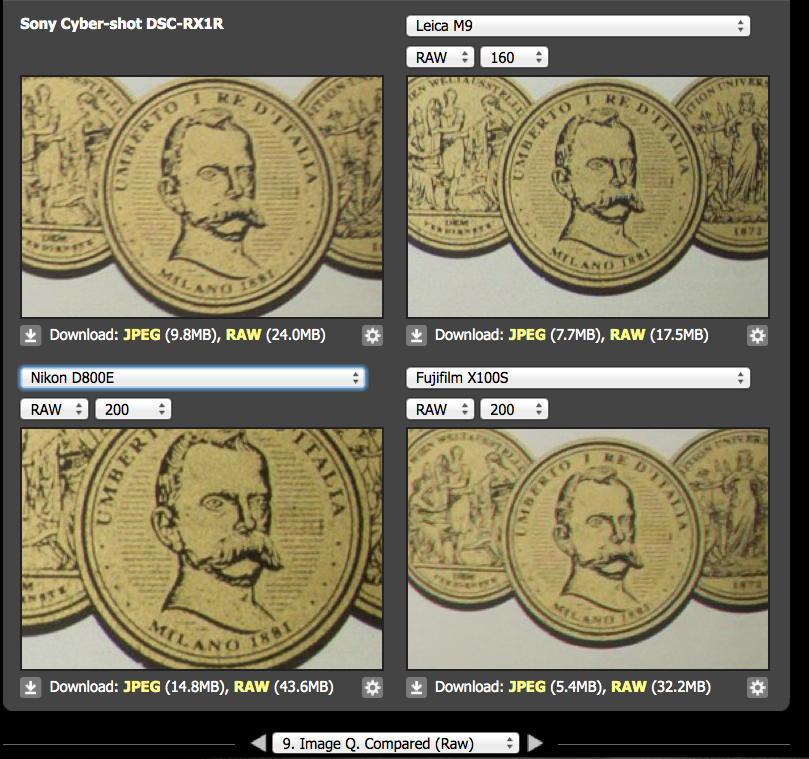
And here are the (left) side 100% crops of the above scene, from each camera, focusing on the label of the Martini bottle (see the red arrow above):

(please click on this image to view at MAXIMUM size and sharpness)

Prosophos - dpreview M9 againts latest cameras

(Note: the crops above vary in size, depending on the megapixel count of each sensor.)

See anything, possibly unexpected here, regarding sharpness?

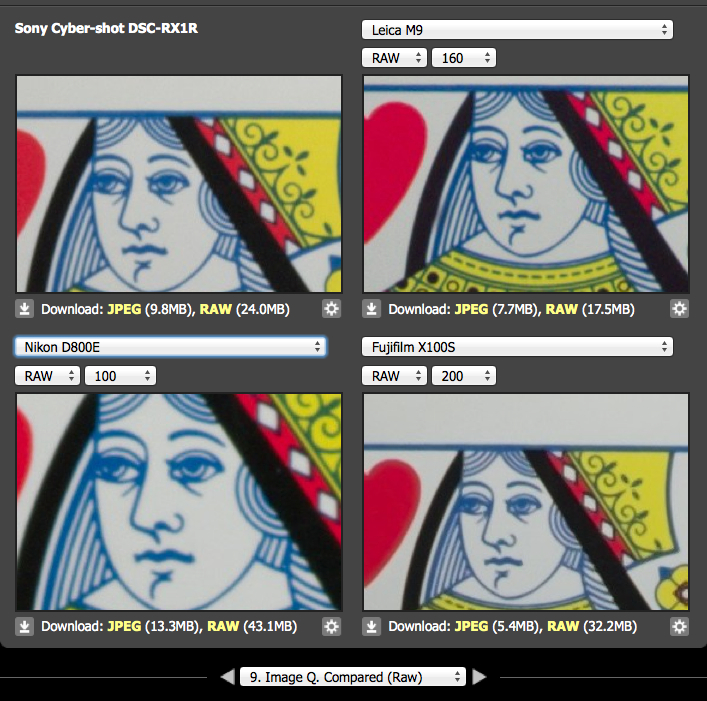
Finally, here are the centre 100% crops , focusing on the Queen of Hearts card in the original scene:

(please click on this image to view at MAXIMUM size and sharpness)

Prosophos - dpreview central 100%

Using the Dpreview comparison tool, one can obviously pick and choose other portions of the scene to make comparisons about sharpness, texture rendering, etc.  I’ve chosen two areas that I believe are representative of lens sharpness performance (corner vs. central) with respect to these cameras (the feathers in the far right of the scene are also worth checking out).

—Peter.

If you haven’t already done so, please consider signing my open letter to Leica.

Prosophos Open Letter to Leica

___

Related posts:

Leica M9 vs. M240 (CCD vs. CMOS)… here we go again.

Inspiration, Q&A, Teaching point

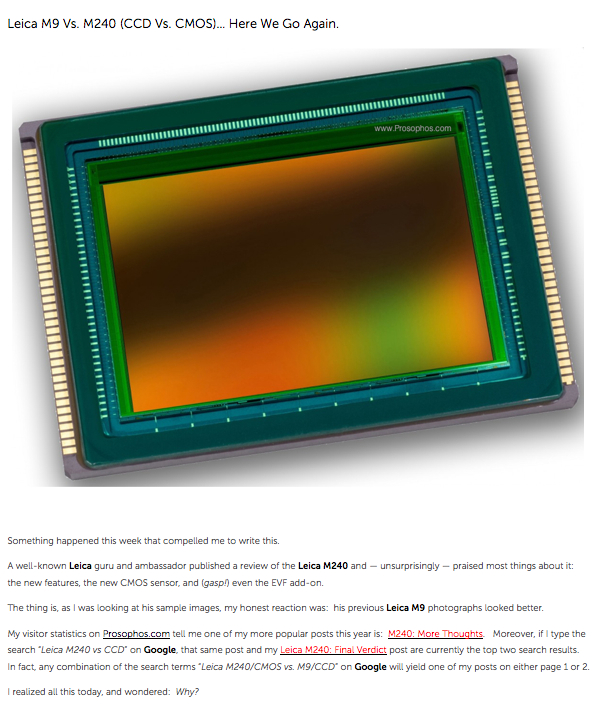
Leica M(240) CMOSIS sensor

Something happened this week that compelled me to write this.

A well-known Leica guru and ambassador published a review of the Leica M240 and — unsurprisingly — praised most things about it: the new features, the new CMOS sensor, and (gasp!) even the EVF add-on.

The thing is, as I was looking at his sample images, my honest reaction was:  his previous Leica M9 photographs looked better.

My visitor statistics on Prosophos.com tell me one of my more popular posts this year is:  M240: More Thoughts.   Moreover, if I type the search “Leica M240 vs CCD” on Google, that same post and my Leica M240: Final Verdict post are currently the top two search results.   In fact, any combination of the search terms “Leica M240/CMOS vs. M9/CCD” on Google will yield one of my posts on either page 1 or 2.

I realized all this today, and wondered:  Why?

My best guess is that many of you see what I see, that the Leica M9 beats the M240 in the only thing that counts: image quality.

And no amount of cheer-leading for the latest and greatest will change that.

So I’ll keep photographing with my antiquated M9 until the successor to the M240 arrives.  And when that happens, if Leica sticks with a CMOS sensor (which they most certainly will), hopefully they’ll have enough sense to strike a deal with Sony.

—Peter.

If you haven’t already done so, please consider signing my open letter to Leica.

Prosophos Open Letter to Leica

___

Related posts:

100% feedback on ebay.

Q&A, Teaching point

Ebay

So what does it mean when you see a “mint” Leica M3 listed on ebay from a seller who, after thousands of transactions, has 100% positive feedback?

It means you’re pretty safe to buy this M3, which is advertised as perfect — including the “vulcanite” covering, which is described as “original and complete”.

Right?

Well, have a close look:

Ebay M3 - 1

Do you see it?

Ebay M3 - 2

Look carefully at the back door covering – it actually differs from the rest of the camera.  Therefore, it’s not all original.

And that’s just the tip of the iceberg when it comes to what’s wrong with this camera, which has been put on sale for a premium, because it was “owned by a collector who kept it in its box” for the last 50+ years.

Right.

Bottom line:  It’s difficult to know who to trust on ebay — so be careful.

—Peter.

My camera of the year for 2013: Leica M9.

Q&A, Teaching point

Leica M9

The Leica M9.

Yes, it’s still that good, nearly four years after its introduction.

(that’s an eternity for digital cameras)

And yes, that’s just my opinion, hence the word “My” in the title.

As of this date, 99% of the images on this site have been made using this iconic camera.

I’ve been tempted by the Nikon D800, the Sony RX1, and the Leica M Monochrom (I haven’t been tempted by the Leica M240), but I keep reaching for the Leica M9.

—Peter.

If you haven’t already done so, please consider signing my open letter to Leica.

Prosophos Open Letter to Leica

___

Related posts: