This is a test shot using my recently acquired used Mamiya tilt/shift accessory on Fuji instant (“Polaroid”) film.
No alcohol was harmed during the testing process.
↑Mamiya RZ67, Mamiya 180mm @ f/4.5, tilt/shift accessory, and Fuji FB-3000.
This is a test shot using my recently acquired used Mamiya tilt/shift accessory on Fuji instant (“Polaroid”) film.
No alcohol was harmed during the testing process.
↑Mamiya RZ67, Mamiya 180mm @ f/4.5, tilt/shift accessory, and Fuji FB-3000.
Ever since I acquired the Mamiya RZ67, I have been searching for a specific accessory item for it.
The trouble is, it is difficult to find a used example of this piece. And brand new, it sells for more than what I paid for my entire (used) Mamiya kit.
However, last week I found a mint copy of what I was looking for, at an exceptionally low price. I thought it was too good to be true, until it arrived this week.
–
–
(the above image was taken with my new digital set-up: the Nikon D800E and Zeiss Otus 55mm @ f/1.4)
↑Leica M9 and Voigtländer Nokton 40mm @ f/1.4.
–
I am amazed at how many of you correctly deduced either the lens or camera, based on the two “test images” I posted over the last 24 hours. A few of you even employed a psychological analysis of me to come up with your answer.
The first person to correctly guess both camera and lens, even before the first test shot, was Johannes. Impressive predictive prowess, my friend.
Honourable mention goes to Andrew, who correctly guessed the lens and steadfastly held on to his prediction.
So here I go… on to a new adventure.
Please be patient with the images. The M9 + 50 Summilux ASPH pairing produces a different look, there is no doubt. In many ways I prefer its rendering to my new gear (the M9 has a CCD sensor that is superior — at base ISO — to any of the current CMOS offerings, and Leica lenses are of course legendary).
Yet, I’m back to Nikon, where my digital experience was first forged.
In a sense, I’m home again.
—Peter.
Orchids in the evening.
Considering the camera was handheld at a shutter speed of only 1/125 sec, the sharpness is excellent. The shutter vibration is better than what I expected. I’m pleasantly surprised.
The lighting was mixed (natural twilight and nearby incandescent) and the colour is true to what I saw.
Tonality is really nice too.
–
–
Aperture: Undisclosed
Shutter Speed: 1/125 sec
ISO: 400
Camera: Undisclosed
Lens: Undisclosed
For the first time in five years, I am without a digital Leica M (my Leica M9 is gone, and so are my Leica lenses).
I don’t see myself purchasing another digital Leica M again, unless:
–
The Leica M3 and Voigtländer Nokton 40mm are still with me.
The Mamiya RZ67 is with me.
My deep connection to rangefinders will remain with my M3, and I will continue to develop my portrait photography with the formidable RZ67. Both of these are, of course, film cameras.
I’ll therefore be exploring another digital system.
In fact, it’s already in my hands.
—Peter.
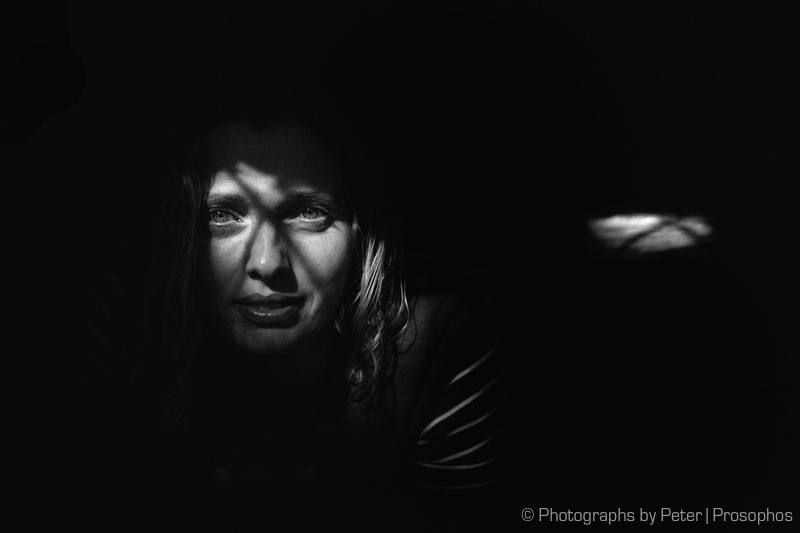
This was shot wide open @ f/2.8, but required a relatively slow shutter speed of 1/30 sec to expose the foreground figures correctly. The camera was braced on the floor to reduce vibration and also to obtain the perspective I was seeking.
I was lucky to hit the shutter at just the right moment — the eye contact was brief.
I wasn’t sure how the 110/2.8 would deal with shooting into the light, but the lens has once again impressed me.
And, I am really enjoying the Mamiya RZ67… more so than I thought I would. Yes, it’s a large and heavy camera, but the system is so well thought out that it prevents you from “screwing up” while delivering exceptional results.
When I purchased my Mamiya equipment, the 180/4.5 lens was also included, but I haven’t yet photographed with it.
—Peter.
↑Mamiya RZ67, Mamiya 110mm @ f/2.8, and Kodak Tri-X 400.
(About a girl and her dog)
This was taken at bedtime, under very dim light. The film was therefore pushed quite a bit during post processing to lighten things (I should have instead “pushed” it during development).
I’m actually amazed that I ended up with an image that I like, given my previous attempts to capture such scenes in my kitchen without the aid of daylight have never produced satisfactory results, with digital cameras (M9, M8, D3S, D3, D700, etc.) anyway. Although film doesn’t make up for poor lighting, it certainly is more forgiving.
—Peter.
↑Leica M3, Voigtländer Nokton 40mm @ f/1.4, and Kodak Tri-X 400.
1/25 sec, ISO 640, f/1.4.
Despite this being a hand-held image at a reasonably slow shutter speed, the in-focus areas readily display the “crisp” rendering we get from CCD sensors.
The colours are remarkable too, considering this was photographed under incandescent light.
(DNG file converted to JPG with no post-processing)
—Peter.
↑Leica M9 and Leica 50mm Summilux ASPH @ f/1.4.
↑Leica M9 and Leica 75mm Summarit @ f/2.5.