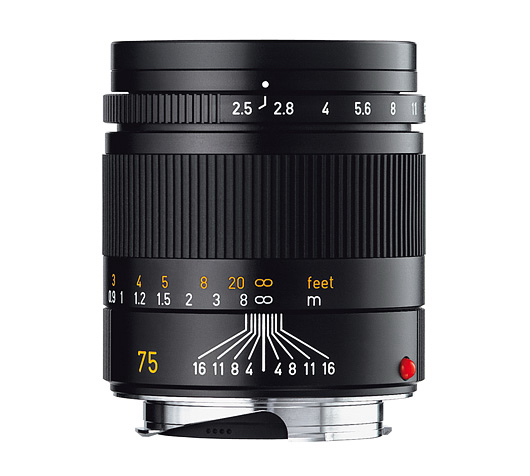
The Leica 75mm Summarit f/2.5 (short review).

2012, Inspiration, Leica 75mm Summarit f/2.5, Leica M9(P)/M-E (CCD Lives!), Teaching point, The Beautiful Game


____________________________

Introduction.

The Leica 75mm Summarit f/2.5 is an optically excellent lens.

THE END.

🙂

That’s really the bottom line, and if that’s all you wanted to know, you can stop reading here.

However, for those of you interested in learning more…

The 75mm Summarit was introduced by Leica in 2007, and — like the rest of the Leica Summarit “budget” line of lenses — was greeted by many Leicaphiles with a great deal of skepticism.  Some viewed it as a somewhat mechanically inferior fashioning from Solms, while others questioned whether its optical performance was commensurate with the highly revered Leica brand.

Were the criticisms fair?  Was it, in fact, a “dumbed-down” Leica lens?

Well… yes and no… or, maybe.

The answer, like most things in photography, is dependent upon whom you ask, and what their particular needs and wants are.

____________________________

Pride and prejudice.

I have this penchant for writing about underdog lenses, like the 75mm Summarit.

It seems strange to label any Leica lens an “underdog”, but there’s a bit of “snobbery” at play when it comes to M mount optics.  Most Leica lens connoisseurs (Note: not necessarily Leica photographers) want nothing less than a Summilux f/1.4 (or faster) Leica lens with the latest technology thrown in.  For those individuals, any lens that is less than this sort of a fast, state-of-the-art lens, is an optic that has been built around a price point and not perfection.

On some level this is, of course, true.  On the other hand, my 75mm Summarit is small, weights 345 grams, balances nicely on my M9, and uses 46mm filters, while my 75mm Summilux is large, weighs 625 grams, tips my M9 forward, and uses 60mm filters.  You see, there’s always a price – beyond the monetary kind – to be paid when choosing a lens… there are multiple trade-offs for every choice made.

As a shooter, I know I prefer the portability and handling of my 75mm Summarit, while of course acknowledging my 75mm Summilux is the better choice for dark environments or for achieving maximum subject isolation.  The “perfect” lens, therefore, is a relative concept, depending on the task at hand.

____________________________

Before continuing…

I’m always careful to represent my lens write-ups as brief user impressions (as opposed to comprehensive reviews) because I want to limit the discussion to issues with which I’ve had direct experience, or which interest me.  To do a proper review would require engaging in all sorts of tedious tests in which I have no interest.

In light of the above, you should be aware that I almost always shoot lenses at their widest aperture and normally photograph people, so bokeh, performance at close-to-mid distances, and central sharpness are important considerations.  On the other hand, I’m rarely concerned with lens performance at infinity or in the corners because I don’t often shoot landscapes.

The rest of this write-up, then, will concentrate on how the 75mm Summarit behaves within these very strict parameters.  In this way, I hope to reliably convey why I appreciate this lens.

____________________________

75mm frame lines, and Leica.

This is a bit of a diversion, but it’s an important one.

The 75mm focal length is an odd one for M rangefinders, because proper viewfinder frame lines for it don’t exist.  In fact, when you connect a 75mm lens to the camera, you get a partial connect-the-lines outline of a small box that sits inside the larger and much more visible 50mm frame line box.  In the image below, I’ve schematically overlaid the 50mm and 75mm “boxes” onto a sample image, to illustrate the point:

(please click on the image to view)

↑Schematic of viewfinder: 75mm (red) + 50mm (black) frame lines.

In this image, the lines which I’ve arbitrarily coloured red represent the 75mm “box” and the black lines correspond to the 50mm “box”.  Both of these “boxes” are seen in the viewfinder when you connect either a 50mm or 75mm lens to a Leica rangefinder.  The idea is to compose your photo with the correct frame lines and then press the shutter.

You can therefore see how easily it would be to unintentionally crop while photographing with a 75mm lens because your eye is more readily drawn to the outer, more solid 50mm box, and not the inner, more fragmented 75mm box.  For example, if I mounted a 75mm lens onto my M9 and took the shot above, as framed, I would end up cutting off the heads and feet of several people in the scene.

For many Leica rangefinder photographers then, the 75mm focal length is entirely avoided, in favour of either 50mm or 90mm (which brings up its own set of frame lines).

Why, then, am I interested in shooting with a 75mm lens?

I like to shoot portraits.  I sometimes find the 50mm focal length to be too short for individual head-and-shoulder shots, and the 90mm focal length to be a little long – even though longer lenses tend to flatter faces.  When shooting at 90mm, I need to be relatively far from my subjects to get the composition I desire, and this inhibits me from closely interacting with them (close interaction, I believe, is vital for coaxing a person’s personality into an image).  The 75mm focal length, then, serves as my “just right” perspective for shooting intimate portraits.

Also, a pairing of the 35/75mm focal lengths makes for a diminutive and very versatile lens travel kit, so a light-weight 75mm lens like the Summarit is a welcomed member of any travel lens arsenal.

____________________________

Central sharpness and bokeh.

I find 100% crop image comparisons to have little relevance to good photography.  Ultimately, I know that inspired shooting has less to do with lens sharpness, bokeh, or any of the other lens characteristics people obsess over (and yes, I’ve been guilty of obsessing over these too), and more to do with harnessing good light, capturing a special event, or evoking an emotional response.

However, I realize that lens comparisons are necessary when entering into an earnest discussion about, well… lenses.   To that end, I’ve included a small sample of 100% crops in this write-up.

Seeing as a 75mm lens should ideally be measured up against another 75mm lens, I have chosen to compare my 75mm Summarit (f/2.5) with my 75mm Summilux (f/1.4).  I don’t currently have access to the 75mm Summicron (f/2), so it’s not included here.

Since this is a big-budget website, I’ve spared no expense in setting up this demonstration.  I’ve hired a professional model, Rapunzel, and draped her over an exotic Subaru. 😉

Not very politically correct, I’m afraid.  All joking aside, here are the images…

_

DISCLAIMERThis is not intended to be an exhaustive analysis of these two lenses. Not even close!  I shot this small comparison for my own purposes and I’m simply posting the results for your viewing pleasure and/or interest.  You may choose to draw you own conclusions, but please don’t write to me that “this is not a valid comparison, because…“.  

I know it’s not a valid comparison.

_

In the images below, the 75mm Summarit and 75mm Summilux were shot on an M9 @ f/2.5 and f/2.4, respectively.  I also shot the 75mm Summilux wide open @ f/1.4.  No sharpening or post-processing was performed, other than converting the original file from DNG to JPG .  The M9 was shot fully in manual mode.  The focus was on my “model”, Rapunzel, and focus bracketing was employed to ensure that the sharpest image from each lens was used for the comparison.

So here is the overall scene:

(please click on the image to view)

↑Leica M9 and Leica 75mm Summarit @ f/2.5.

_

Now, here are are the 100% centre crops:

(please click on the image to view LARGE)

↑75mm Summarit @ f/2.5 + Summilux @ f/2.4 and f/1.4 (centre 100% crop, no sharpening)

When you click on the panel above, the one thing that strikes you immediately is that both lenses are extremely sharp (remember, these are unsharpened 100% crops — astounding, when you think about it).  And even @ f/1.4, the 75mm Summilux is almost maximally sharp, which is incredible, when you consider the advanced age of this optic.

The second thing to notice, which is more difficult to see and perhaps not visible at all unless you’re viewing these on a large screen, is that the 75mm Summarit @ f/2.5 is a tiny bit sharper than the 75mm Summilux @ f/2.4 (and @ f/1.4).  It’s a subtle but real finding.

The third, and perhaps most subtle finding, is that the background immediately behind the model’s head  — which in actuality represents the beginning of the bokeh — appears sharper (or some would say harsher) in the 75mm Summarit @ f/2.5 vs. the 75mm Summilux @ f/2.4.  Of course, the smoothest background is seen with the 75mm Summilux @ f/1.4.

Does this observation about bokeh hold up, the further back we go? 

Let’s look at a crop from the candle holder, on the right side of the frame.

Here are the right 100% crops:

(please click on the image to view LARGE)
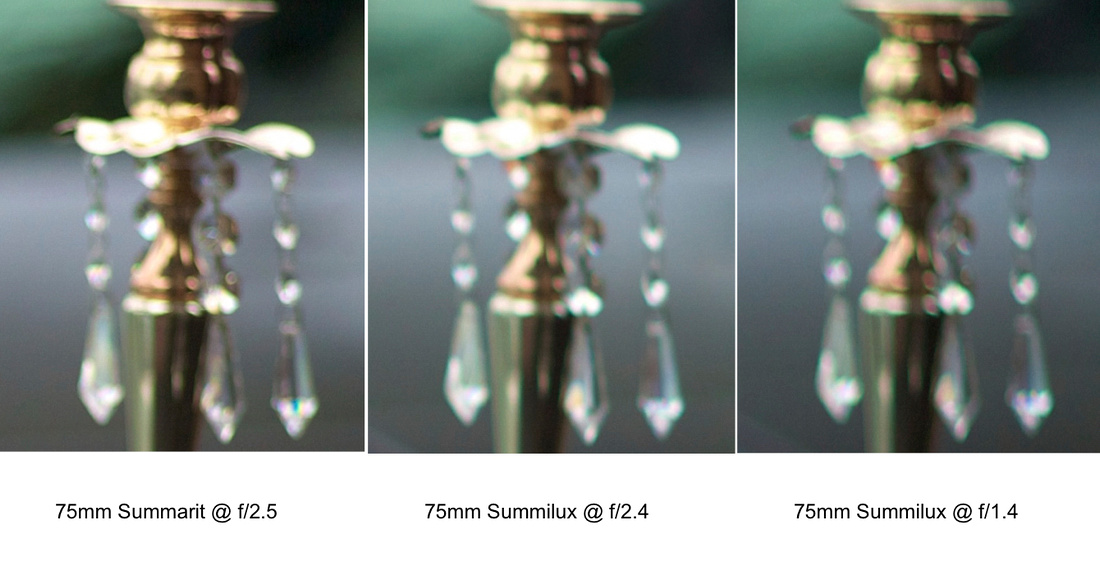
↑75mm Summarit @ f/2.5 + Summilux @ f/2.4 and f/1.4 (right 100% crop, no sharpening)

Once more, the bokeh of the Summarit @ f/2.5 appears slightly sharper (harsher) than the Summilux @ f/2.4.  I’m splitting hairs here, but that’s what one does when viewing 100% crops.

Finally, let’s go back further and look at the bokeh where the spot of light is, near the top of the frame.

Here are the top 100% crops:

(please click on the image to view LARGE)

↑75mm Summarit @ f/2.5 + Summilux @ f/2.4 and f/1.4 (top 100% crop, no sharpening)

Yet again, the 75mm Summarit @ f/2.5 renders its bokeh in a slightly sharper/harsher fashion, as compared to the 75mm Summilux @ f/2.4. 

What’s  interesting in this shot, however, is that the shape of the out-of-focus light source is more pleasingly round in the 75mm Summarit @ f/2.5 as compared to the 10-sided  shape (decagon) we get with the 75mm Summilux @ f/2.4.  In contrast, the 75mm Summilux @ f/1.4 has a pleasing oval shape (and you will also note that the frame is a little darker because this lens vignettes @ f/1.4).

____________________________

Portraits.

So, there you have it.

Does the above matter for actual photography?  No, not at all.

For example, I’ve found the 75mm Summarit to be an excellent portrait lens:

(please click on the images to view)

Mike, the worker (75mm Summarit @ f2/.5).

↑Leica M9 and Leica 75mm Summarit @ f/2.5.

Autumn Chestnut

↑Leica M9 and Leica 75mm Summarit @ f/2.5.

↑Leica M9 and Leica 75mm Summarit @ f/2.5.

↑Leica M9 and Leica 75mm Summarit @ f/2.5.

Sisters

↑Leica M9 and Leica 75mm Summarit @ f/2.5.

2 Souls

↑Leica M9 and Leica 75mm Summarit @ f/2.5.

Occasionally, when the background is distracting, the bokeh can seem less than perfect (see the fence below), but this would be true of any lens at f/2.5 (meaning, you’d have to use an f/1.4 or wider aperture lens to overcome this sort of a background — and even then it would be a challenge):

(please click on the image to view)

↑Leica M9 and Leica 75mm Summarit @ f/2.5.

If there’s any criticism I have for the 75mm Summarit is that it is perhaps too sharp for certain kinds of portraits, where you don’t necessarily wish to see every wrinkle or skin blemish!

____________________________

Ergonomics and handling.

One of the most useful things about this lens is its short focus throw.  What this means, in practical terms, is that I can focus between the extremes of near and far with a short turn of the focus ring.  The “price” you pay for this is a loss of focus precision, but this is less of a problem when focusing a 75mm lens @ f/2.5  (the maximum aperture of the 75mm Summarit) vs. focusing @ f/1.4 (the maximum aperture of the 75mm Summilux — which, quite appropriately, has a long focus throw).

The 75mm Summarit’s short focus throw makes it possible to photograph action:

(please click on the images to view)

↑Leica M9 and Leica 75mm Summarit @ f/2.5.

↑Leica M9 and Leica 75mm Summarit @ f/2.5.

↑Leica M9 and Leica 75mm Summarit @ f/2.5.

↑Leica M9 and Leica 75mm Summarit @ f/2.5.

The beautiful game - the Ecstasy

↑Leica M9 and Leica 75mm Summarit @ f/2.5.

↑Leica M9 and Leica 75mm Summarit @ f/2.5.

Leader of the Pack

↑Leica M9 and Leica 75mm Summarit @ f/2.5.

↑Leica M9 and Leica 75mm Summarit @ f/2.5.

↑Leica M9 and Leica 75mm Summarit @ f/2.5.

↑Leica M9 and Leica 75mm Summarit @ f/2.5.
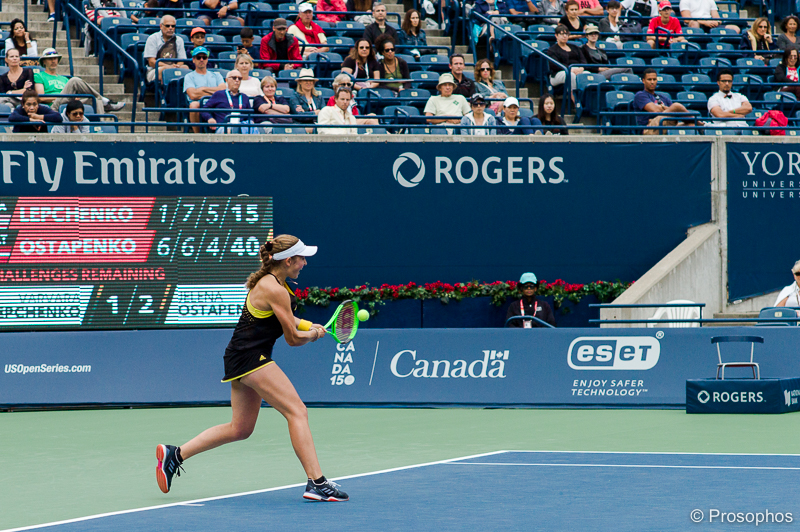
↑Leica M9 and Leica 75mm Summarit @ f/2.5.

↑Leica M9 and Leica 75mm Summarit @ f/2.5.

As for weight and size, I’ve already mentioned that this lens is very portable.  It doesn’t come with a built-in hood, however, which is a shame.

Another strike against the 75 Summarit is its minimum focus limit of 0.9 m, which is short of the 0.75 m limit of the 75mm Summilux (or the 0.7 m limit of the 75mm Summicron).  A difference of 15 or 20 cm may not seem like much, but it feels substantial when trying to get close to your subject.   As I mentioned earlier, the ability to get close when shooting portraits is of vital importance to me, so this is probably the biggest issue I have against the 75mm Summarit (*Update:  the newer 75/2.4 Summarit has a minimum focus distance of 0.7 m – hooray!).

And what about build quality?

The two Summarit lenses I own (the 75mm and the 35mm) do not feel quite as substantial in the hand as their Summicron or Summilux brethren.  Now, I don’t know how much of that is secondary to the relative paucity of glass required for an f/2.5 optic vs. an f/2 or f/1.4, and how much of that is secondary to a difference in build quality, but that’s the impression.  That’s not to say that the Summarits feel cheap – far from it, they are of excellent build quality with precise aperture clicks and very smooth focusing rings.  And remember, having a lighter lens that is capable of top-notch optical performance is not such a bad thing.  In fact, one could say that it is very much in line with the original Leica philosophy 🙂 .

____________________________

More Sample Images.


____________________________

Conclusion.

The Leica 75mm Summarit (f/2.5) is capable of rendering with impressive sharpness and very pleasing bokeh.  It’s perhaps too sharp for some types of portraiture and its bokeh may be marginally less smooth as compared to some of Leica’s finest   A major shortcoming is its minimum focus limit of 0.9 m.  The only other limitation is its maximum f/2.5 aperture, which is only a problem if you require wider apertures — in which case, you shouldn’t be looking at an f/2.5 lens.  In the final analysis, however, the 75mm Summarit is an excellent optic in a small package that, in most applications, simply excels.

—Peter | Prosophos.

____________________________

If you would like to see more of my images with the Leica 75mm Summarit f/2.5, please click here.


Looking up, poolside (Part I).

2012, Inspiration, Leica 75mm Summilux (Canada 🇨🇦) f/1.4, Life's Little Moments, Portrait, Sports, Teaching point

This is one of those moments that works.  The moment before and the moment after just didn’t measure up, despite having identical lighting, composition, and subject matter.

So, what’s the difference?  It’s her.  It’s her head tilt and accompanying expression… the spark that illuminated her face the moment the camera shutter was released.

It’s an example of what I’ve previously referred to as one of Life’s Little Moments.

(please click on the image to view)

↑Leica M9 and Leica 75mm Summilux @ f/1.4.

If you’re “just” photographing your family…

2012, Inspiration, Portrait, Teaching point

If you’re “just” photographing your family, get the BEST photo equipment you can afford (that you are able to use, or can learn to use).

— Peter | Prosophos.

___________

I was prompted to write the above after reading yet another, “if you’re just photographing your family, get a cheap point-and-shoot” comment on one of the internet forums.  It always leaves me shaking my head when I come across that sort of statement, not because I have anything against inexpensive cameras (which I’ve used and continue to use, and which can be used to take wonderful photos), but because of the implication behind the words, that – for whatever reason – your family is not worthy of the best* equipment.

Nonsense.

Documenting your family’s timeline – the various trials and tribulations, the tears, the joy, the exciting, the mundane, the…  the anything – is one of the most important things you can do with a camera.  The snobbery around exclusively using “pro” equipment (whatever that is) to photograph athletes, celebrities, or otherwise “important” individuals is laughable.  As if most of us are able to remember more than a handful of “pro” magazine cover images we’ve ever seen…

Instead, it’s all those images reminding us of the births, marriages, and deaths of our loved ones, that burn themselves into our brains.

—Peter.

[Note: I also posted this on SteveHuffPhoto.com]

___________

*Note:  best does not necessarily equate with biggest.

(Un)policed smiles.

2012, Inspiration, Konica Hexanon 60mm f/1.2, Portrait, Teaching point

The law wasn’t broken here, but a rule was.

A shallow depth of field was used to unconventionally blur the foreground figure (policewoman).  It’s an unconventional choice because your mind normally expects the most foreground elements to be in focus.  Violating this “rule” can prove for a distracting image, but I believe it works here because of the particular composition and because the two officers are mirroring each other with their expressions.

(please click on the image to view)

↑Leica M9 and Konica Hexanon 60mm @ f/1.2.

Q and A: Voigtländer Nokton 40mm f/1.4.

2012, Q&A, Teaching point, Voigtländer 40mm f/1.4 Nokton

This arrived via email this morning and I was about to respond as I usually do, but then realized, I often get this question, so why not turn my response into a post that will hopefully be of help to other readers?


Hi. I read your review for the The Voigtländer Nokton 40mm f/1.4. and found it very helpful. I have this lens with a Leica M9 and don’t seem to be getting the results you pictured. Did you alter your M9 shots in Lightroom or do you have the lens detection set a specific way in the M9 for the The Voigtländer Nokton 40mm f/1.4? My shots tend to come out overexposed when I use it open to 1.4. Any suggestions would be appreciated. Thanks and keep up the good work. Your photos and reviews are great.

– Adam.

First of all, thank you Adam for your very kind words.

Now, regarding your questions…  I post-process all of my files in Apple’s Aperture and then do my final colour tweaking in Nikon’s Capture NX2.  On the M9, I have lens detection set to “auto”, but I do not code any of my uncoded lenses, so for lenses like the Nokton 40/1.4 the camera isn’t recognizing anything and is therefore NOT making any adjustments.  For focal lengths longer than 35mm, there really is no need for coding anyway, unless you’re hoping to correct for vignetting or are interested in generating focal length EXIF data.

Finally, I always shoot in manual mode (controlling for aperture and shutter speed) and often manually set the ISO.   I never rely on the camera’s metering.  I’ve done this with ALL of my cameras, including Nikon, Canon, Sigma, etc., because no camera – not matter how sophisticated – truly understands what your “mind’s eye” is seeing when you attempt to create an image, and it’s better that you take full control of all the variables.

I hope this helps.

Thanks again for writing Adam, and Happy New Year,

—Peter.

Stacked.

Inspiration, Print, Teaching point, Zeiss ZM 21mm f/2.8 T* Biogon

The unusual clustering of people caught my eye.

On a technical note, this photo is stacked in more than one way: the clouds serve as counterbalance to complete the composition.

The image is courtesy of the Zeiss ZM 21/2.8.  I don’t use this lens often, but when I do, I am always astounded by its rendering.

(please click on the image to view)

↑Leica M9 and Zeiss ZM 21/2.8 @ f/4.

The tractor driver.

Inspiration, Konica Hexanon 60mm f/1.2, Portrait, Teaching point

That warm glow imbuing every element in this scene is courtesy of the rising sun.

When photographing, it’s all about the light — you have to work to find it, and you can’t fake or photoshop it.  In this scene, it’s permeating everything: his face, the tractor, the clouds… like dabbles of fluorescent paint.

(please click on the image to view)

↑Leica M9 and Konica Hexanon 60mm @ f/1.2.

The jogger.

Inspiration, Leica 135mm Tele-Elmar f/4 (1966), Portrait, Teaching point

Illuminated by a glorious sunrise.

Even @ f/5.6, this 1966 Tele-Elmar 135mm is capable of producing some seriously shallow depth of field… the runner looks like he’s a cut-out figure pasted onto the scene.

By the way, I’ve tried using the Tele-Elmar at its widest aperture of f/4, but the rendering there isn’t as sharp.

This is definitely a daylight lens, but a great daylight lens.

Also, I’ve been pleasantly surprised to find that — despite the longish 135mm focal length — the Tele-Elmar has proven easier to focus accurately than many of my mid-range lenses.

(please click on the image to view)

↑Leica M9 and Leica Tele-Elmar 135mm f/4 @ f/5.6.

The parade.

Inspiration, Konica Hexanon 60mm f/1.2, Portrait, Teaching point

Taken during the 2011 Santa Claus Parade, in Toronto, Canada.

The Konica Hexanon 60mm f/1.2, when shot wide open on the M9, yields a unique visual imprint that I find quite interesting.  It is, for example, quite different from what I get with the Noctilux f/1.0.

If anybody out there can articulate the differences, I’d be happy to read your thoughts.  To view a small (and not-so-rigorous) comparison between these two lenses, please see here.

(please click on the image to view)

↑Leica M9 and Konica Hexanon 60mm @ f/1.2.

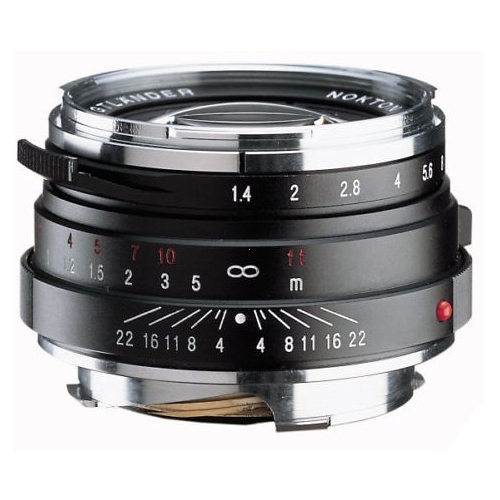
Leica Boutique and my Voigtländer Nokton 40mm f/1.4 write-up!

Teaching point, Voigtländer 40mm f/1.4 Nokton

Ever since I wrote a piece about the Voigtländer Nokton 40mm f/1.4 back in July, it’s become one of my more popular posts.

It’s no wonder, since this little gem of a lens has always been underrated but is increasingly gaining its share of admirers as people explore the various mirrorless camera platforms (as well as classic rangefinder photography, of course).

One of those admirers of the little Nokton 40 is my friend Jean Bardaji, the distinguished owner of Leica Boutique in Montreal, Canada.  Jean is very knowledgeable and passionate about photography and has long appreciated the little Nokton Classic MC 40/1.4.

So, when Jean recently decided to link to my write-up on the Leica Boutique Voigtländer page of his website (click into Voigtlander Nokton Classic MC F1.4/40mm), I was quite honoured.

Jean has actually sold me two copies of this lens, as I have always found his prices on Voigtländer (and Zeiss) lenses to be the most competitive in the market.  More than that, his service has always been exceptional.

So I wish to thank Jean, for all of his help and would not hesitate to recommend the services of Leica Boutique to anyone looking for this lens (or any other).

– Peter | Prosophos.

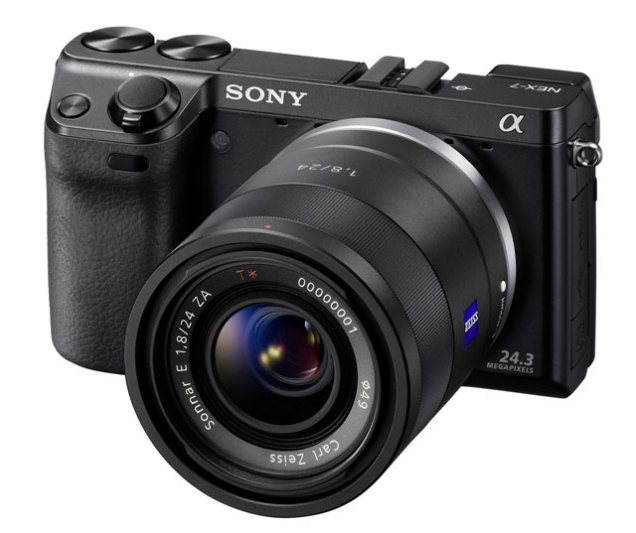
The Sony NEX-7 – I’ll take a pass (for now).

Inspiration, Teaching point

Lenses, they say, are forever.  Not so with camera bodies… especially in the digital age.  They are essentially electronic devices, ultimately to be disposed of – regardless of the initial purchase price.

Despite this, last year I purchased a Leica M9 – a decidedly expensive digital camera.  The obvious question, in light of the above, is:  Why?

Well, the M9 has the form factor, sensor size, rangefinder focusing, performance at base ISO, and accompanying M lenses that make it a formidable photographic tool.  To the point:  it was the only camera currently out there that had all the traits I valued… it was the only game in town, so to speak.

But I know that one day it will fail beyond repair.

And, as an avid Leica “M” platform shooter, one of the things I think about is whether I’ll be able to afford another Leica M camera when my M9 eventually fails.  Every year, the good folks at Leica increase their prices and – in one fell swoop – prove wrong all those reasonable folks who believed the gear was overpriced in the first place.  I don’t know when the M10 will arrive, but I can guarantee you that it will cost more than the M9P, which cost more than the M9, which cost more than M8.2, which cost more than the M8… you get the “picture”, right?

Given this, I’ve tried to build some security into – tried to future-proof – my M camera system by securing film Leica M bodies that will last “forever” (or at least my lifetime… or for as long as film continues to be manufactured 🙂 ), but let’s face it, sometimes the convenience of digital calls out like a siren song.

But now is an exciting time for photographers.  New mirrorless interchangeable lens camera systems are being introduced at a quick pace that – via an appropriate adapter – will work with all of my beloved M lenses (Leica, Voigtlander, and Zeiss).  The camera in this class that is currently getting the most attention, for a variety of good reasons, is the upcoming Sony NEX-7.  Yup – upcoming, as in: it hasn’t even been released yet.

So this is a long preamble to get to the crux of this post, but here it is:  I’m not buying into any of the announced systems.  Not yet, anyway.

No thank you Olympus, no thank you Panasonic, no thank you Samsung, no thank you Ricoh, and no thank you Sony.  All of you are tempting me, but… no thank you.

However, the truth is, you guys are the future and I will eventually turn to you.

Why am I not buying now?

Admittedly, Sony’s NEX-7 and Ricoh’s A12 “Leica M-mount” module represent exciting developments in digital photography.  I am genuinely excited about what these manufacturers are doing because – first and foremost – they appear to be listening to the enthusiasts out there.   But I’m not buying into any of these systems yet because I believe Sony, Ricoh, and the others can and will do better.

In what way?

At some point, somebody will release a NEX-7-like camera with a “full-frame” (24 x 36) digital sensor – the kind that, similar to the M9, will take full advantage of the optics in the M lenses I value.

Regardless of whether I’m using my lenses on a camera body with a micro four thirds, APS-C, or larger “full” frame sensor, they remain the size they are, so I may as well use them on a body with a 24 x 36 sensor that will exploit them to their full potential.  And as good as the new crop of APS-C sensors are, the same technology in a larger sensor will yield better image quality – that’s a physical reallity.

The first manufacturer, other than Leica, who places a 24 x 36 sensor in a mirrorless interchangeable lens camera can count me in as a customer.  I have no doubt that at some point, somebody will do it.

Until then, I will resist the temptation to buy.  I mean, I already have an M9 so I have no immediate need to purchase another camera body… although I understand the attraction for those who are without a digital M and are just itching to use their old beloved M lenses on a digital sensor, or for those without legacy lenses who plan on buying the new lenses that are being offered with the new platforms.

Yes, I’ll continue to shoot with my M9 – and hope that it doesn’t fail…

…at least until Sony, Ricoh, or somebody else, finally does what we’ve all been waiting for.

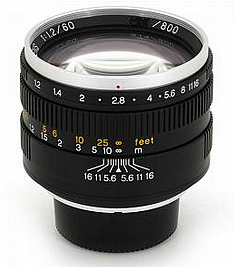
The Konica Hexanon 60/1.2 vs. Leica Noctilux 50/1.0 shot wide open.

Konica Hexanon 60mm f/1.2, Leica 50mm Noctilux f/1, Teaching point

This post is meant to serve as a little bit of an interlude from the Sunrise at Oxtongue Lake series…

DISCLAIMER:  This is not intended to be an analysis of these two lenses. Not even close!  I shot these for my own curiosity and am simply posting the results for your viewing pleasure and/or interest.  You may choose to draw you own conclusions, and that’s fine (in fact, I’m interested in reading your comments).  But please, please, don’t write that “this is not a valid comparison, because…“.   I know it’s not a valid comparison.

Below, the Konica Hexanon 60/1.2 and Leica Noctilux 50/1.0 (E60) were shot wide open on the M9 (the reason one buys these exotic lenses is to shoot them wide open, so that’s the comparison that interested me).

The M9 was set to manual mode.  Focus bracketing was used and the sharpest images from each lens were taken for the comparison (NOTE: despite doing this to ensure that the images were in focus, sharpness was not the only thing I was interested in).

Finally, the original DNG files were converted to JPG in Aperture.  No post-processing whatsoever was used, other than the conversion.

So, here is the overall scene…  focus was on the word “TATiRi” on the guitar head (the differences in the field of view are attributable to the 50mm and 60mm focal lengths).

(please click on the images below to view)

↑Konica Hexanon 60/1.2 @ f/1.2.

↑Leica Noctilux 50/1.0 @ f/1.0.

That famous peripheral “swirly” pattern of the Noctilux f/1.0 is certainly evident above (as an aside, the Nikkor Noct 58/1.2 is also famous for this).

And now I’m including several 100% crops from the above scenes.  The first pair of crops are meant to demonstrate central sharpness.

(please click on the images to view)

↑Konica Hexanon 60/1.2 @ f/1.2 (centre 100% crop)

↑Leica Noctilux 50/1.0 @ f/1.0 (centre 100% crop)

The next several pairs of crops are meant to demonstrate the character of the bokeh, as seen in two different regions from the main scene.

↑Konica Hexanon 60/1.2 @ f/1.2 (bottom left 100% crop)

↑Leica Noctilux 50/1.0 @ f/1.0 (bottom left 100% crop)

↑Konica Hexanon 60/1.2 @ f/1.2 (top centre 100% crop)

↑Leica Noctilux 50/1.0 @ f/1.0 (top centre 100% crop)

As I wrote above, I’d be interested in reading any commentary generated from this.

Sunrise at Oxtongue Lake, Part III of VII.

Inspiration, Print, Teaching point, Zeiss ZM 21mm f/2.8 T* Biogon

Parts I and II of this series are here and here.

(please click on the image to view)

↑Leica M9 and Zeiss ZM 21mm @ f/2.8.

The focus was on the boat, of course, and you can see the out-of-focus treeline and fog in the background.  Just how sharp is the Zeiss ZM 21/2.8?

Here is the 100% centre crop @ f/2.8 – this is the original file with no sharpening:

(please click on the image to view)

↑ Zeiss ZM 21mm @ f/2.8 (100% crop, no sharpening)

Clearly the Zeiss, beyond being sharp and possessing incredible resolving power – beginning at f/2.8 – renders in a contrasty and substantial way (for lack of a better term)… elements seem to jump out of the image (the so-called 3D effect) despite the large depth of field a wide angle lens normally affords.

A truly remarkable lens.