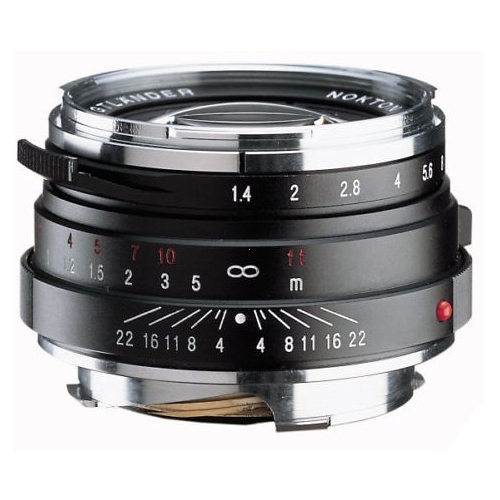
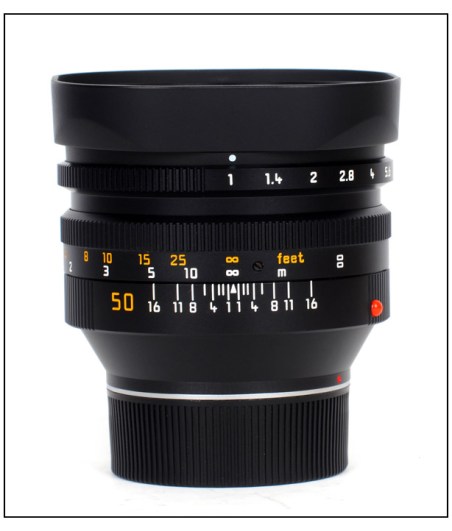
Leica Boutique and my Voigtländer Nokton 40mm f/1.4 write-up!

Teaching point, Voigtländer 40mm f/1.4 Nokton

Ever since I wrote a piece about the Voigtländer Nokton 40mm f/1.4 back in July, it’s become one of my more popular posts.

It’s no wonder, since this little gem of a lens has always been underrated but is increasingly gaining its share of admirers as people explore the various mirrorless camera platforms (as well as classic rangefinder photography, of course).

One of those admirers of the little Nokton 40 is my friend Jean Bardaji, the distinguished owner of Leica Boutique in Montreal, Canada.  Jean is very knowledgeable and passionate about photography and has long appreciated the little Nokton Classic MC 40/1.4.

So, when Jean recently decided to link to my write-up on the Leica Boutique Voigtländer page of his website (click into Voigtlander Nokton Classic MC F1.4/40mm), I was quite honoured.

Jean has actually sold me two copies of this lens, as I have always found his prices on Voigtländer (and Zeiss) lenses to be the most competitive in the market.  More than that, his service has always been exceptional.

So I wish to thank Jean, for all of his help and would not hesitate to recommend the services of Leica Boutique to anyone looking for this lens (or any other).

– Peter | Prosophos.

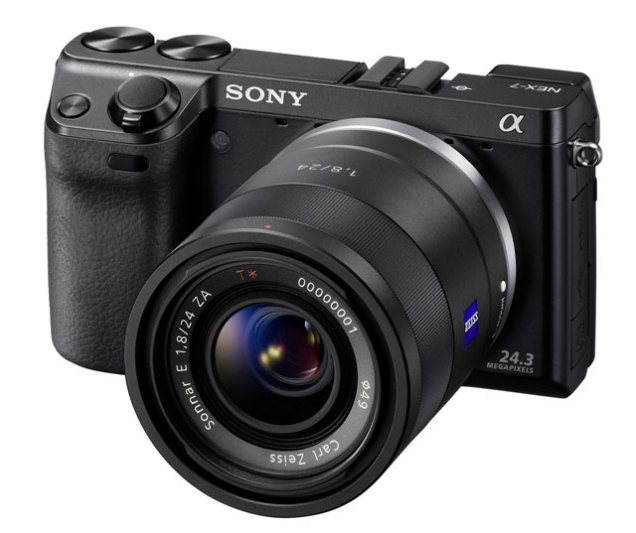
The Sony NEX-7 – I’ll take a pass (for now).

Inspiration, Teaching point

Lenses, they say, are forever.  Not so with camera bodies… especially in the digital age.  They are essentially electronic devices, ultimately to be disposed of – regardless of the initial purchase price.

Despite this, last year I purchased a Leica M9 – a decidedly expensive digital camera.  The obvious question, in light of the above, is:  Why?

Well, the M9 has the form factor, sensor size, rangefinder focusing, performance at base ISO, and accompanying M lenses that make it a formidable photographic tool.  To the point:  it was the only camera currently out there that had all the traits I valued… it was the only game in town, so to speak.

But I know that one day it will fail beyond repair.

And, as an avid Leica “M” platform shooter, one of the things I think about is whether I’ll be able to afford another Leica M camera when my M9 eventually fails.  Every year, the good folks at Leica increase their prices and – in one fell swoop – prove wrong all those reasonable folks who believed the gear was overpriced in the first place.  I don’t know when the M10 will arrive, but I can guarantee you that it will cost more than the M9P, which cost more than the M9, which cost more than M8.2, which cost more than the M8… you get the “picture”, right?

Given this, I’ve tried to build some security into – tried to future-proof – my M camera system by securing film Leica M bodies that will last “forever” (or at least my lifetime… or for as long as film continues to be manufactured 🙂 ), but let’s face it, sometimes the convenience of digital calls out like a siren song.

But now is an exciting time for photographers.  New mirrorless interchangeable lens camera systems are being introduced at a quick pace that – via an appropriate adapter – will work with all of my beloved M lenses (Leica, Voigtlander, and Zeiss).  The camera in this class that is currently getting the most attention, for a variety of good reasons, is the upcoming Sony NEX-7.  Yup – upcoming, as in: it hasn’t even been released yet.

So this is a long preamble to get to the crux of this post, but here it is:  I’m not buying into any of the announced systems.  Not yet, anyway.

No thank you Olympus, no thank you Panasonic, no thank you Samsung, no thank you Ricoh, and no thank you Sony.  All of you are tempting me, but… no thank you.

However, the truth is, you guys are the future and I will eventually turn to you.

Why am I not buying now?

Admittedly, Sony’s NEX-7 and Ricoh’s A12 “Leica M-mount” module represent exciting developments in digital photography.  I am genuinely excited about what these manufacturers are doing because – first and foremost – they appear to be listening to the enthusiasts out there.   But I’m not buying into any of these systems yet because I believe Sony, Ricoh, and the others can and will do better.

In what way?

At some point, somebody will release a NEX-7-like camera with a “full-frame” (24 x 36) digital sensor – the kind that, similar to the M9, will take full advantage of the optics in the M lenses I value.

Regardless of whether I’m using my lenses on a camera body with a micro four thirds, APS-C, or larger “full” frame sensor, they remain the size they are, so I may as well use them on a body with a 24 x 36 sensor that will exploit them to their full potential.  And as good as the new crop of APS-C sensors are, the same technology in a larger sensor will yield better image quality – that’s a physical reallity.

The first manufacturer, other than Leica, who places a 24 x 36 sensor in a mirrorless interchangeable lens camera can count me in as a customer.  I have no doubt that at some point, somebody will do it.

Until then, I will resist the temptation to buy.  I mean, I already have an M9 so I have no immediate need to purchase another camera body… although I understand the attraction for those who are without a digital M and are just itching to use their old beloved M lenses on a digital sensor, or for those without legacy lenses who plan on buying the new lenses that are being offered with the new platforms.

Yes, I’ll continue to shoot with my M9 – and hope that it doesn’t fail…

…at least until Sony, Ricoh, or somebody else, finally does what we’ve all been waiting for.

The Konica Hexanon 60/1.2 vs. Leica Noctilux 50/1.0 shot wide open.

Konica Hexanon 60mm f/1.2, Leica 50mm Noctilux f/1, Teaching point

This post is meant to serve as a little bit of an interlude from the Sunrise at Oxtongue Lake series…

DISCLAIMER:  This is not intended to be an analysis of these two lenses. Not even close!  I shot these for my own curiosity and am simply posting the results for your viewing pleasure and/or interest.  You may choose to draw you own conclusions, and that’s fine (in fact, I’m interested in reading your comments).  But please, please, don’t write that “this is not a valid comparison, because…“.   I know it’s not a valid comparison.

Below, the Konica Hexanon 60/1.2 and Leica Noctilux 50/1.0 (E60) were shot wide open on the M9 (the reason one buys these exotic lenses is to shoot them wide open, so that’s the comparison that interested me).

The M9 was set to manual mode.  Focus bracketing was used and the sharpest images from each lens were taken for the comparison (NOTE: despite doing this to ensure that the images were in focus, sharpness was not the only thing I was interested in).

Finally, the original DNG files were converted to JPG in Aperture.  No post-processing whatsoever was used, other than the conversion.

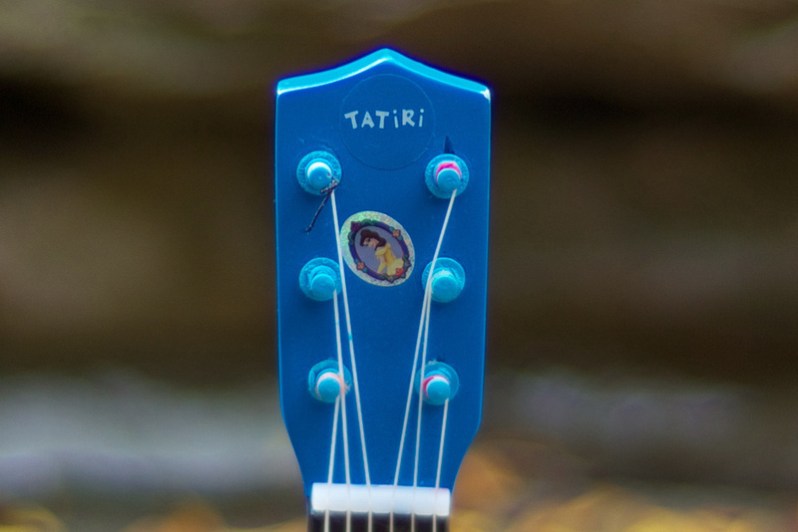
So, here is the overall scene…  focus was on the word “TATiRi” on the guitar head (the differences in the field of view are attributable to the 50mm and 60mm focal lengths).

(please click on the images below to view)

↑Konica Hexanon 60/1.2 @ f/1.2.

↑Leica Noctilux 50/1.0 @ f/1.0.

That famous peripheral “swirly” pattern of the Noctilux f/1.0 is certainly evident above (as an aside, the Nikkor Noct 58/1.2 is also famous for this).

And now I’m including several 100% crops from the above scenes.  The first pair of crops are meant to demonstrate central sharpness.

(please click on the images to view)

↑Konica Hexanon 60/1.2 @ f/1.2 (centre 100% crop)

↑Leica Noctilux 50/1.0 @ f/1.0 (centre 100% crop)

The next several pairs of crops are meant to demonstrate the character of the bokeh, as seen in two different regions from the main scene.

↑Konica Hexanon 60/1.2 @ f/1.2 (bottom left 100% crop)

↑Leica Noctilux 50/1.0 @ f/1.0 (bottom left 100% crop)

↑Konica Hexanon 60/1.2 @ f/1.2 (top centre 100% crop)

↑Leica Noctilux 50/1.0 @ f/1.0 (top centre 100% crop)

As I wrote above, I’d be interested in reading any commentary generated from this.

Sunrise at Oxtongue Lake, Part III of VII.

Inspiration, Print, Teaching point, Zeiss ZM 21mm f/2.8 T* Biogon

Parts I and II of this series are here and here.

(please click on the image to view)

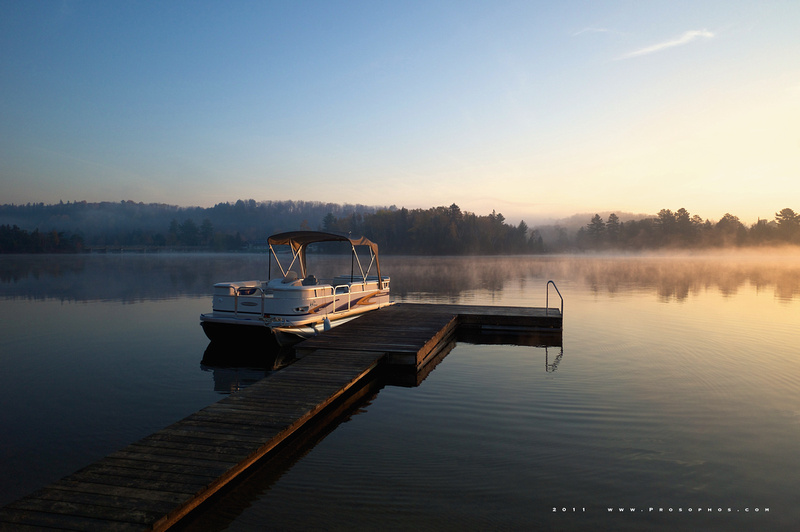
↑Leica M9 and Zeiss ZM 21mm @ f/2.8.

The focus was on the boat, of course, and you can see the out-of-focus treeline and fog in the background.  Just how sharp is the Zeiss ZM 21/2.8?

Here is the 100% centre crop @ f/2.8 – this is the original file with no sharpening:

(please click on the image to view)

↑ Zeiss ZM 21mm @ f/2.8 (100% crop, no sharpening)

Clearly the Zeiss, beyond being sharp and possessing incredible resolving power – beginning at f/2.8 – renders in a contrasty and substantial way (for lack of a better term)… elements seem to jump out of the image (the so-called 3D effect) despite the large depth of field a wide angle lens normally affords.

A truly remarkable lens.

Over-processed, not.

Leica M2, Teaching point, Voigtländer 40mm f/1.4 Nokton

I always have to remind myself not to over-process my images.

It used to be the domain of poor HDR photography practitioners, but now I see “over-cooked” images everywhere.  What’s worse is that few people are objecting to it.

Don’t get me wrong, I shoot in raw format and process ALL of my images, sometimes using various software plug-ins – which I suspect are the most popular tools employed by the offending photo-chefs.

And, especially in my novice days, I have been guilty of over-processing too.  Moreover, I’m sure in a few years I’ll look back at my current digital output and label it as garish.

However, I’ve been shooting a lot with film lately.  I’m doing this mostly because my mood and creative juices are calling for it…. something to do with the darker, cooler season of autumn.

In doing so, I’m always reminded of how a photograph should look.

–

↑Leica M2 and Voigtländer Nokton 40mm @ f/1.4.

–

Nothing flashy.  Nothing exciting.  But real.

I know digital and film, in their native state, look different so I’m not trying to emulate one with the other.

I still go ahead and process the film images I’ve scanned into my computer, though – fortunately – it’s harder to screw around with them… but not impossible.   This limitation helps me understand what I should be striving for when processing digital images.

Keeping it real, so to speak.

—Peter.

Running.

Inspiration, Leica 75mm Summilux (Canada 🇨🇦) f/1.4, LFI Master Shot, Portrait, Teaching point

The exhilaration of being, on a sunny autumn day.

This photo was chosen as a Leica Fotografie International (LFI) Master Shot.

(please click on the image to view)

↑Leica M9 and Leica 75mm Summilux @ f/1.4.

As you can see, the 75mm Summilux produces an extremely shallow depth of field at f/1.4.  Nailing focus here – while he is running towards me – is tricky.

Further complicating things is the long focus throw of the 75/1.4, which is designed for precision and not for speed.

I rarely get this kind of shot with this lens, at this aperture… and to have caught him in mid-stride was the icing on the cake.

A walk with (and “testing” out) the Leica 50mm Noctilux f/1.0 (E60).

Inspiration, Leica 50mm Noctilux f/1, Teaching point

As I previously posted, I recently acquired a Leica Noctilux f/1.0 and added it to the stable of lenses I normally use.

Now, I am not a lens tester by any stretch of the imagination – I don’t photograph test charts, or brick walls; I don’t place my camera on a lab bench with a tripod taking repeated measurements.

But, like all disciplined photographers, I do carefully observe how each of my lenses behave under different shooting circumstances.  I pay particular attention to each lens’ strengths and weaknesses in environments in which I regularly find myself, and – finally – look for the general character of the image output.  That’s what I’m most interested in.

By doing this, I have conceptually set aside certain lenses for daylight use, for low-light, for action, for situations where cold-hard details are required, for situations where soft and dreamy portraits are my priority, for scenes in which “interesting” bokeh is desired, for scenes where neutral and smooth bokeh is preferred, etc.  Each lens has a particular flavour that potentially lends itself to a given situation.

So, that being said, I took out my new-used Noctilux f/1.0 for a walk – to start acquainting myself with it.

Normally on this site, I only post photos that have some emotional significance to me.  However, I thought some of the the sample images from my “test” walk would be of general interest.

Please note that all of these images were shot at f/1.0 – the aperture in which I’m most interested.  A neutral density filter was used to overcome the brightness of shooting at f/1 in daylight.

The first thing I was looking for was general sharpness.  Lens sharpness isn’t everything, but it is important.  It’s the one thing you can’t add to a photo during post-processing, if the photo is blurry to begin with (whereas you can always take a sharp photo and make it blurry).

When I write sharpness, I’m referring to central image sharpness and not sharpness across the field.  As a (mainly) portrait shooter, I really don’t care if the corners of an image are blurry – in fact that’s a positive thing for me.  Landscape shooters, of course, would care.

The first image is of a Monarch butterfly I encountered:

(please click on any of the images below)

↑Leica M9 and Leica f/1.0 Noctilux @ f/1.0.

The sharpness seems pretty good (the focus was on the butterfly, of course).  The bokeh looks pretty good too – smooth but not too smooth for my taste.

Let’s look at the 100% crop.  The sharpness holds up but we also see something commonly encountered with fast lenses shot at their widest apertures:  purple fringing.
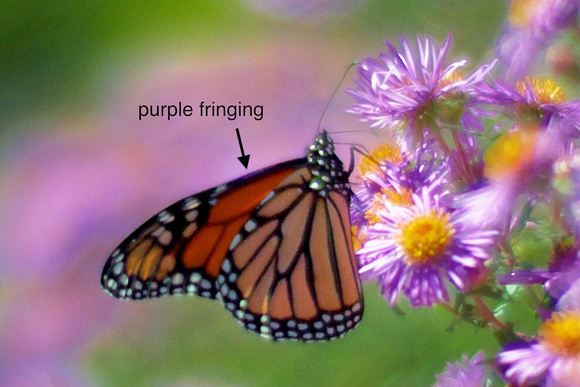
↑Leica M9 and Leica f/1.0 Noctilux @ f/1.0 (100% crop).

Purple fringing tends to occur in high contrast transition points, typically on the edge of dark structures  – in this case the edge of the butterfly wing – against bright backgrounds.  In actuality, purple fringing is an example of longitudinal chromatic aberration (forget the technical stuff, just know when you’re likely to see it, as I’ve illustrated above).

Let’s look at another image.

I next encountered this scene of a man sitting on a park bench and focused on him:

(please click on any of the images below)
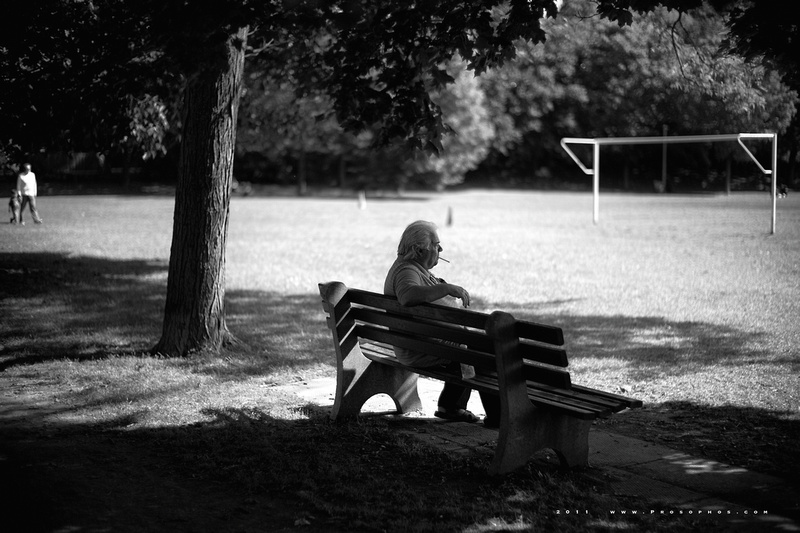
↑Leica M9 and Leica f/1.0 Noctilux @ f/1.0.

And here is the 100% crop:

↑Leica M9 and Leica f/1.0 Noctilux @ f/1.0 (100% crop).

Once again, pretty darn good considering this was shot at f/1.0 in harsh daylight!  It’s not as sharp as the (newer) Noctilux f/0.95 ASPH is at f/1.0, but the “old” Noctilux’s ability to capture details is mighty impressive.  I would go further to say that I appreciate the character of this lens at f/1.0 more than of the newest ASPH Noctilux.   It’s hard to explain, but this old Noctilux seems to create images where the in-focus elements are simultaneously sharp and soft… Again, perfect for portraits.

OK, enough of sharpness and image crops.

The other thing I noticed while shooting was that at f/1.0 this Noctilux vignettes.  Here is an image where the vignette has been exaggerated by adding contrast to the image as a whole (i.e., I did not add a vignette, but by adding contrast to the entire image, the vignetting that was naturally produced by the lens was exaggerated):

(please click on the image below)
↑Leica M9 and Leica f/1.0 Noctilux @ f/1.0.

Why am I evaluating vignetting in an image that I’ve already post-processed?  Well, as I wrote above, I’m not scientifically evaluating but I’m examining this lens under the conditions in which I work.  In the native file, I already see the vignetting but, by adding contrast to it, the vignetting is emphasized.

Again, vignetting may be a negative thing, depending on your style of photography, but I appreciate it in the case of portraiture, where the darkened borders help to “bring out” the central subject.

Speaking of “bringing out” the subject, I’ll include two more images taken during my walk that I believe highlight the subject isolation abilities of this lens, when shot at f/1.0:

(please click on any of the images below)

↑Leica M9 and Leica f/1.0 Noctilux @ f/1.0.
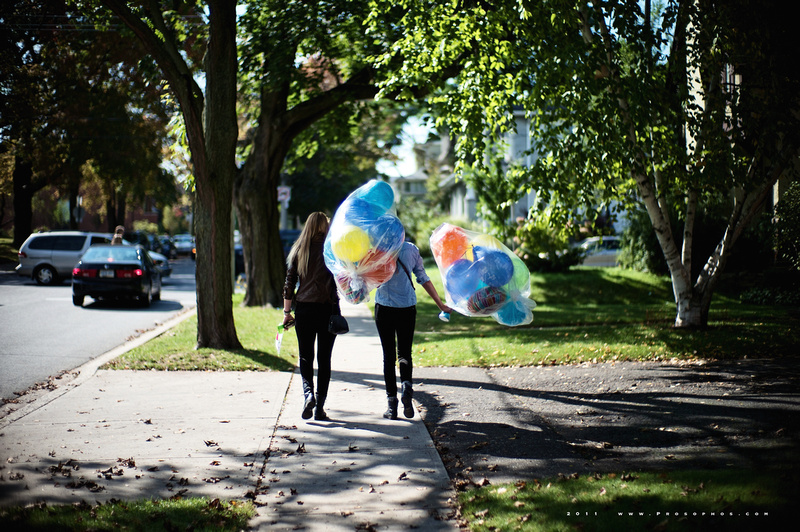
↑Leica M9 and Leica f/1.0 Noctilux @ f/1.0.

What do I mean by subject isolation?  In each of the above images, the in-focus elements seem to “pop-out” of the image; some refer to this as the “3D” effect.  Whatever you call it, this look is secondary to the shallow depth of field conferred by shooting at f/1.0.  At f/1.0, there is only a razor-thin plane where things are going to be in-focus; the rest of the scene will out-of-focus.  This is one of the qualities people covet when they seek out a lens like the Noctilux and why they shoot at f/1.0 – even in daylight.

I could write more (about bokeh, flare resistance, etc.) but this discussion is already proving to be lengthy so ‘ll end it here for now.

OK, I lied… here is one more 100% crop, of the Balloon Walk image above:

(please click on the image below)

↑Leica M9 and Leica f/1.0 Noctilux @ f/1.0 (100% crop).

You can actually read the Happy Birthday text on the balloons; as I wrote above, the in-focus elements in the image are simultaneously sharp and soft – I really appreciate this.

Thanks for taking the time to read this.

If you wish to view more of my images taken with this lens, as I keep shooting with it, please click on the link here.

_____________________________

Please donate to this site!

Please show your appreciation for this article!

If you’ve been helped by this article, or any of my other articles, please consider making a contribution to help me run Prosophos.com.  Whether it’s $1, $5, or $10… it all helps.

This site is a labour of love, but any help I receive will help me devote more time to running it.

Thanks,

—Peter.

The look.

Inspiration, Konica Hexanon 60mm f/1.2, Portrait, Teaching point

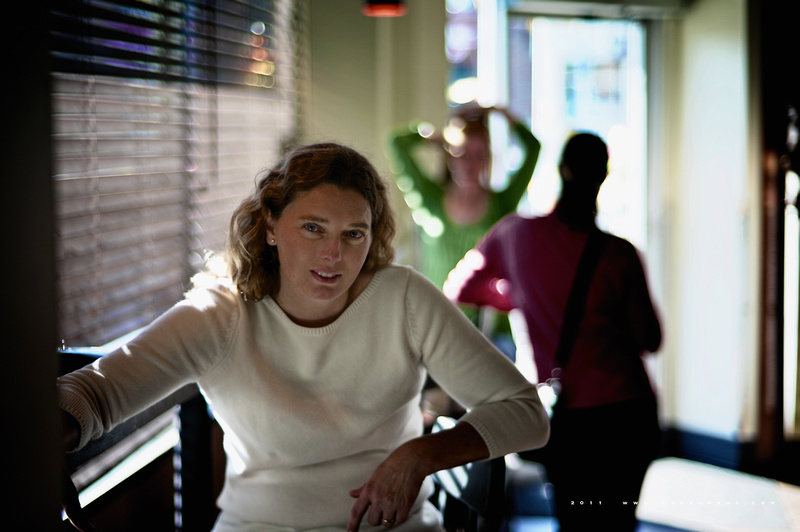
I know it too well.  She’s wondering if she’s ever going to get her coffee.

The lighting was tricky here… mixed natural and incandescent.   On the other hand, the blinds shielded against the harshest of the outside light and things balanced nicely.

(please click on the image to view)

↑Leica M9 and Konica Hexanon 60mm @ f/1.2.

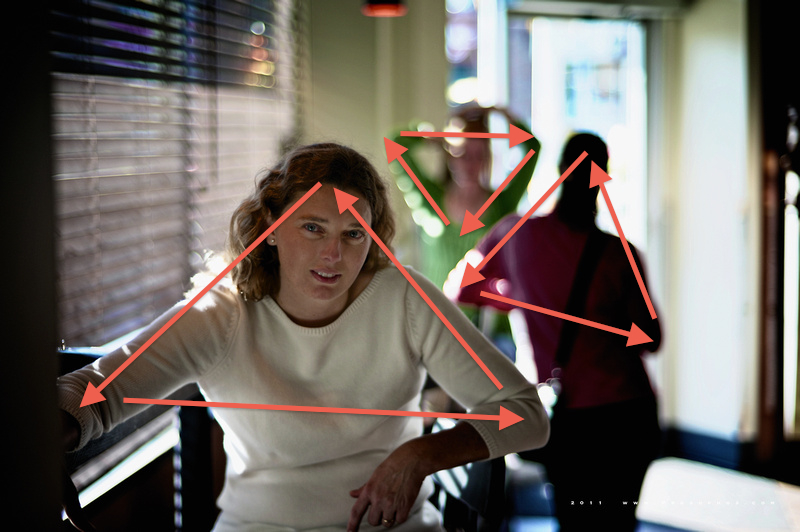
I love how the girl furthest back, by adjusting her hair the moment the shutter was released, has filled out the composition:  her posture creates an inverted triangle that fits like a puzzle piece between the triangles formed by the postures of the two figures closest to us.  It is difficult to explain so here is a visual of what I mean:

She did get her coffee, eventually.

Levels.

Inspiration, Leica 50mm Summicron f/2, Photo Shoot, Teaching point

This shot is unsuccessful.

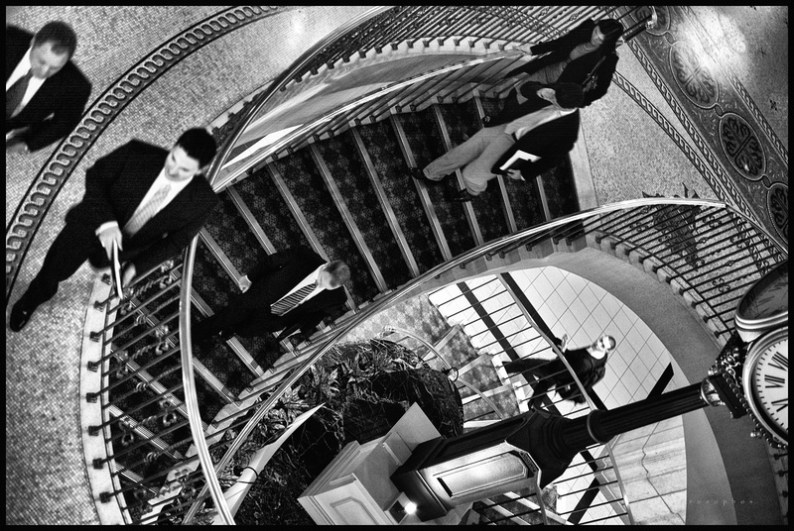
The scene is from the lobby of the Royal York Hotel in Toronto where an interesting vantage point is afforded by the arrangement of the floors and spiral staircases – it sets up an almost Escher-like effect on the brain.

(please click on the image to view)

↑Leica M9 and Leica 50mm Summicron @ f/2.

My goal was to capture the bustling movement of people, on each level, including the connecting staircase.  The first strike against success was the lens  – I had a 50mm, and I needed a 35mm.  Consequently, the frame is tilted in order to try to “fit” more of the scene into the field of view (this somewhat contributes to the general visual disorientation so it’s not such a bad thing).  The second – and more fatal – strike was that, despite the constant flow of human traffic, there was never any satisfactory simultaneous distribution of people amongst the levels.  Despite waiting for it to happen, it never materialized.

Still, I kept this shot as a token for my efforts.  I do like the fact that the man in mid-step (bottom right) has spotted me, despite being two levels beneath me.

One rung at a time.

Inspiration, Portrait, Teaching point, Voigtländer 40mm f/1.4 Nokton

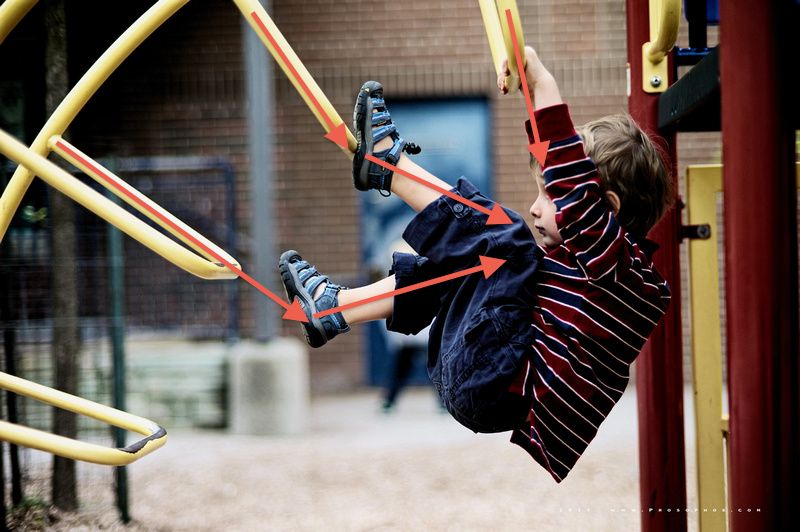
I captured a few frames during this sequential climb, but this one – with the searching foot – ultimately prevailed.

(please click on the image to view)

↑Leica M9 and Voigtländer Nokton 40mm @ f/1.4.

After studying this for a while, I realized why I preferred this image to the others.

The floating foot, adds a dynamic quality to the image.  We know he’s climbing, but with the foot between rungs, his movement is emphasized and there is a (tiny) sense of drama: will he find his footing?

More than this, the same lower foot, though not connected to the rung, completes a rung-to-limb schematic echoed in the two rungs above, that ultimately converges and directs our attention to his face (see red arrows below):

(please click on the image to view)

It’s interesting to tease these little visual cues out, though I’d much rather enjoy the images for what they are: precious, personal moments… frozen in time.

Gelato (and sharpness of the Konica Hexanon 60mm @ f/1.2).

Inspiration, Konica Hexanon 60mm f/1.2, Portrait, Teaching point

So, here’s our young lad eating some yummy gelato.

(please click on the image to view)

↑Leica M9 and Konica Hexanon 60mm @ f/1.2.

I am always in awe at what fast rangefinder lenses – in this case, the Konica Hexanon 60mm f/1.2 LTD – can do @ f/1.2.   Firstly, there is the subjective dream-like quality to the images.  Secondly, on the technical side, the sharpness wide open is remarkable.  Have a look at the 100% crop, where the focus is on the eye:

(please click on image to view)

↑Leica M9 and Konica Hexanon 60mm @ f/1.2 (100% crop, no sharpening).

With all the difficulties in nailing focus manually, on a moving target at f/1.2 with a back-focusing lens, it’s this sort of result that inspires me to keep shooting.

Jump! And, some thoughts on image creation.

Inspiration, Konica Hexanon 60mm f/1.2, Portrait, Teaching point

I often try to photograph in an unobtrusive manner because there is a natural rhythm to people and events to which the shutter release should be timed.  Snapping a photo at the wrong moment is like cutting against the grain, singing off key, or attempting to be somebody you’re not… it just doesn’t feel right.

When shots are planned – more likely than not – the smiles will be strained, the postures will be tense, the natural rhythm will be off.  This is of course unless you’re dealing with professional models, though even then introducing some spontaneity into the proceedings is a good thing.

Having written all this, I sometimes plan a shot, such as this one:

(please click on the image to view)

↑Leica M9 and Konica Hexanon 60mm @ f/1.2.

I asked C to jump.  That’s the planned part.  However, the act of jumping creates some fluidity because she’s concentrating on jumping and not posing.  Also, creating this image on the street allows for other elements to be introduced into the scene.  In this case, the passing couple wonderfully completes the composition – something for which I didn’t plan.

Lucky for me.

Something happening.

Inspiration, Leica 35mm Summarit f/2.5, Teaching point

Posting photos with commentary – like I do on this blog – is new to me.  I used to just post photos, free of my interpretation, because I believed the images should stand on their own merit.  Interpretation would be left to the viewer.

I still believe that, but I’ve obviously softened my stance – hence this blog.

However, I’m posting this image, which I will leave hanging, unadorned by words (other than the title, “Something happening”).

I took it yesterday.  Today I’ll leave the details up to you.

I’m curious as to what you dream up.

(please click on the image to view)

Leica M9 and Leica 35mm Summarit @ f/2.5.