
↑Leica M9 and Leica 50mm Summilux ASPH @ f/1.4.

↑Leica M9 and Leica 50mm Summilux ASPH @ f/1.4.
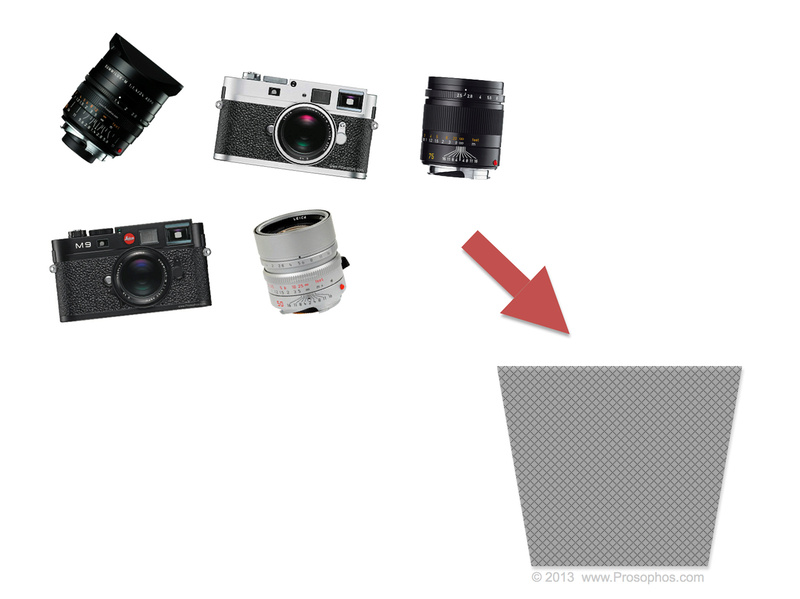
In frustration, I came close to selling all of my Leica equipment a few days ago.
After an ice storm that left this city without power (and some of our fellow citizens still have no heat!), the whole family became ill (and we still are…).
What does this have to do with Leica?
Well, the one day where everything was “normal”, thankfully, was Christmas Day — our power had been restored and we hadn’t yet gotten sick. Naturally, I was looking forward to photographing.
After shooting some frames and reviewing the images, I realized the focus was off! A few key moments were lost (or at least, rendered blurry). I took a few test shots and realized my M9 was back-focusing by about an inch. Enough to mess things up when photographing at f/1.4.
This is one of the charms of rangefinder ownership. The rangefinder focusing mechanism, over time, can spontaneously (or with little provocation) deviate from spec.
No problem, I thought. That’s why I have a back-up M9(P).
So I started photographing with it. But I realized why this camera has been relegated to back-up status. Its buffer chokes up after a few frames and it takes several seconds before I can start photographing again. The outcome: I missed a few more key moments.
A specific charm of Leica ownership is that one M9 can behave in a much different way from another — identical — M9 (with the same SD card and the same firmware!). Leica still hasn’t mastered the whole electronics thing… which may be perceived by some as somewhat of a shortcoming in the digital age.
Back to the story…
Maybe it was because I had spent the weekend and some of the week re-enacting scenes from Pioneer Village, or maybe it was because I was getting sick, but I had had enough!
(I know, I know, these are “First World” problems, and — believe me — I know how fortunate I am. I’m just venting).
I started packing away the M9s.
But what other camera(s) would I now use?
Out of everything currently out there, the only non–Leica camera that will accept my M lenses and give me a full frame sensor is the Sony A7(R). And its CMOS sensor comes the closest to achieving my coveted M9 CCD sensor rendering (the Sony colour signature is another story). But… Leica lenses (especially wide angle ones) don’t necessarily shine on other manufacturers’ platforms. So my pricey Leica Summilux lenses would be worth little on the Sony.
No problem, I thought once more. I’ll just sell my lenses too and start from scratch.
But, but… I used the Sony RX1R earlier this year and the computer-as-camera user interface left me cold. That, and having to rely on the EVF: through it, it didn’t feel like I was watching the world… it felt like I was watching TV.
So I turned my attention to DSLR cameras.
The only contender for me would be the Nikon Df. Small for a DSLR, plenty of external controls for manual shooting, etc. And I was close to purchasing it, despite the downgrade in base ISO image quality it would represent (high ISO functionality is another story).
But I prefer to manually focus. And I’d been-there-done-that with the D3 and D3s, both coupled to a Noct Nikkor 58/1.2 AIS lens. When photographing action wide open, the hit rate with this system is low (even when using the “green dot” focus aid).
Plus, I’ve grown accustomed to the “see the world outside of the frame” view of the rangefinder window. With it, I can see elements outside of what the lens sees, and I can therefore better anticipate how a given moment may unfold.
Finally — believe it or not — I was once more tempted to switch to a new Leica M240. Oh, but the image quality would be… (well, you know). And don’t forget those electronic gremlins, which continue to plague Leica, even with their latest bodies…
In the end, I decided to keep my current gear. Yes, I know… I’ve become predictable.
Which places my photography situation in a precarious position, with respect to any future “upgrade” path.
Hopefully, by the time my current M9 cameras die (or their sensors spontaneously crack — but that’s another story!), there will be other viable options out there for me).
I’m holding out hope for Sony to sort out its user interface, and I’m also closely watching for advances in EVF technology.
Or maybe Leica will finally produce a non-beta version of a camera.
Yes, it’s a love-hate thing.
—Peter.
3 layers of men.
(the 3rd is not the stick figure wheelchair man)
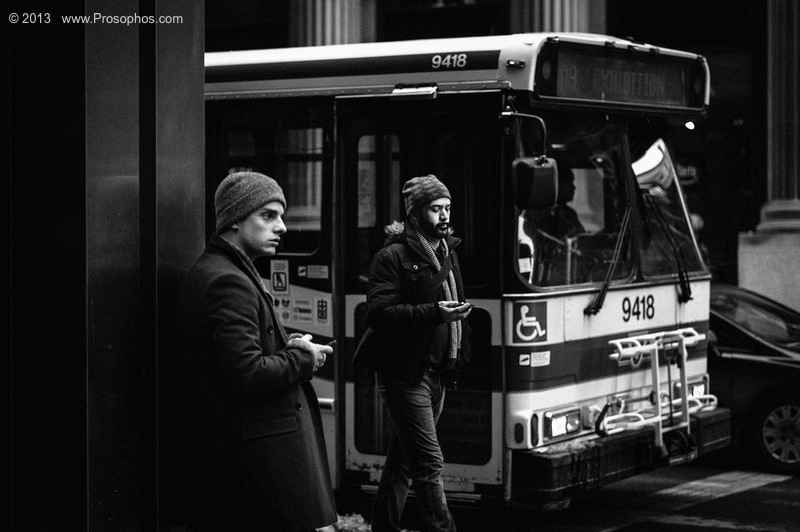
↑Leica M9 and Leica 75mm Summarit @ f/2.5.
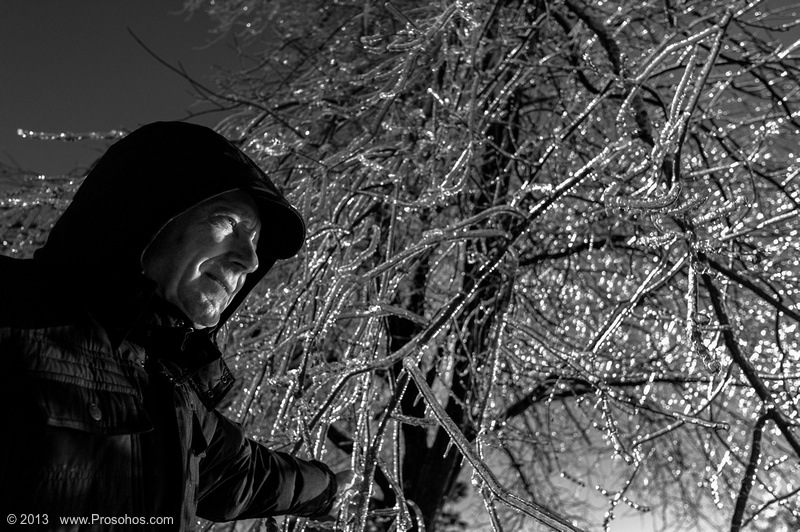
↑Leica M9 and Leica 24mm Summilux @ f/2.8.

↑Leica M9 and Leica 50mm Summilux ASPH @ f/1.4.

↑Leica M9 and Leica 24mm Summilux @ f/1.4.
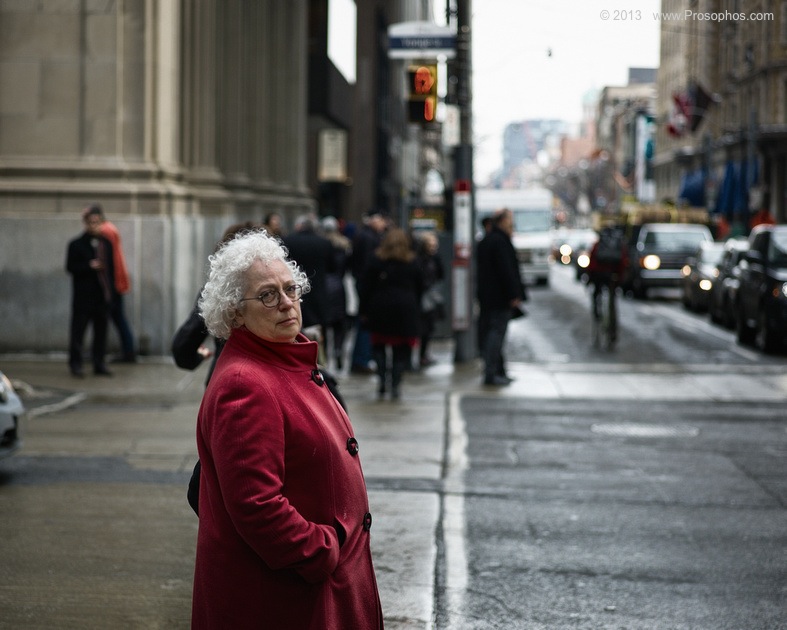
↑Leica M9 and Leica 75mm Summarit @ f/2.5.
Power was restored to our home last night. Good thing, as the temperature inside the house had dropped to 4C.
Just under 200,000 homes (approximately 500,000 people) remain without power this morning and colder temperatures are on the way.
—Peter.
An ice storm hit Toronto this weekend. We, like over 250,000 others in this city, are without electricity and without heat.
—Peter.
–
A number of years ago, Nikon introduced the flagship D3 and changed the face of photography by allowing us to capture images in near darkness. I remember taking an image indoors late one evening in 2007 and marveling at how clean the image looked at ISO 6400.
Yet, these days when I photograph, I preferentially seek good light, and my ISO requirements with an f/1.4 aperture lens rarely exceed 1600. Anything more than this, and I’m basically turning nighttime into daytime — which is often undesirable, as it destroys the ambiance of nighttime scenes.
I’ve learned the obvious: good light is good, and no amount of ISO boosting overcomes the disadvantages of poor light or poor lighting.
–
–
That same ISO 6400 image from six years ago, when viewed now with a more critical eye, falls a little short on an aesthetic level, not because the lighting was dim, but because the lighting was poor.
Poor light is not necessarily the same as weak light. For example, the scant light available after a sunset is “good light”, if one harnesses it properly (with the aid of a tripod and slow shutter speed). The same thing may be said of incandescent lighting, if it is arranged on your subject in a pleasing way.
Good light is not necessarily the same as bright or plentiful light. For example, midday sunlight is often too stark to be desirable for portraiture, but may be perfect if the goal is to capture the interplay of light and shadow.
Admittedly, high ISO capabilities are desirable for specific applications — for example, astrophotography, where the goal is to “see” the faint light emitted by distant stars but the exposure time is kept to a minimum to “freeze” the stars’ movement (so that stars remain “points” of light in the final photograph). Or, if the goal is to capture action in dim light, or to record a memory for posterity and lighting considerations are secondary or beyond one’s control, then yes, a high-ISO-capable camera is vital.
If the goal, however, is to create an aesthetically pleasing photograph — even at night — then seek good light.
—Peter.
Taken yesterday.

↑Leica M9 and Leica 75mm Summarit @ f/2.5.
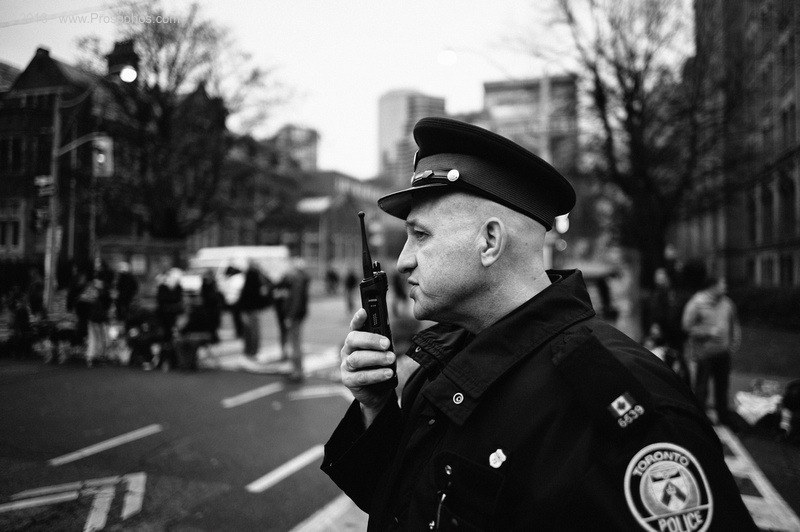
↑Leica M9 and Leica 24mm Summilux ASPH @ f/1.4.
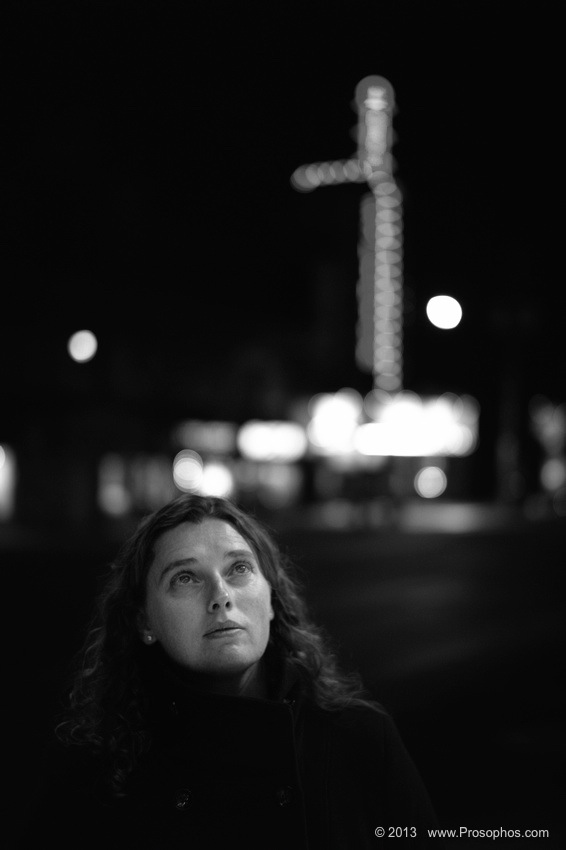
↑Leica M9 and Leica 50mm Summilux ASPH @ f/1.4.

↑Nikon D3 and Nikon 50mm f/1.4 AF-D @ f/13.
Editor’s Note:
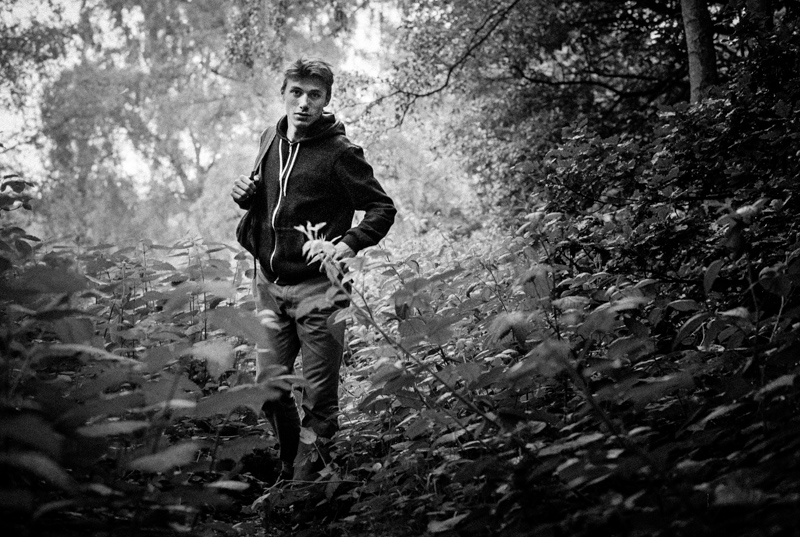
I am pleased to present the B&W film work of Matteo (the same gentleman who inspired this Q&A post yesterday). Lately Matteo has been exploring film and rangefinder photography, and these images were created over the past several months.
–

–

–

–

–

–

–

–
–
Thank you very much, Matteo, for your beautiful submissions.
—Peter.
Matteo writes:
—
Thank you very much Matteo for writing.
Well, it turns out I may have an opinion about the Leica M240… 🙂
As many of the readers of Prosophos.com know, I’ve written much about it:
…And I have even written an open letter to Leica asking for an updated CCD sensor on a future Leica M model. So far, over 130 individuals have signed it.
However, to answer your question in a concise manner, I’ll note three things I don’t appreciate about the Leica M240 sensor:
–
As for the Nikon Df and Sony A7/A7R, they are not rangefinder cameras, and so obviously cannot provide the rangefinder experience, which is important to me. Also, being CMOS sensor cameras, they cannot equal the M9 in Points #2 and #3 above.
That’s basically it. I hope that answers your question Matteo.
Sincerely,
—Peter.
[Incidentally, Matteo has submitted several images to me that will be featured in a not-too-distant Guest Post.]
Together.

↑Leica M9 and Leica 50mm Summilux ASPH @ f/1.4.
—
If you haven’t already done so, please consider signing my open letter to Leica.

___
Related posts:

↑Leica M9 and Leica 24mm Summilux ASPH @ f/1.4.

