I’m the guest speaker at Leica Akademie this weekend.

2012, Inspiration, Q&A, Teaching point

I’m proud to announce that I will be the guest speaker at the Leica Akademie (North America) workshop in Toronto, Canada this weekend.

Mr. Tom A. Smith, the Events & Education Manager of Leica Akademie NA tells me that there is still one spot left for this workshop, so if you’re interested in attending, please see here.

If you can’t attend this weekend, but reside in the Toronto area, please note that I offer practical one-on-one teaching sessions on a year-round basis.

Thanks,

—Peter.

Film processing at home: inexpensive.

2012, Film, Inspiration, Q&A, Teaching point

One of my generous readers, Mark, upon reading Part 1 of my How I process B&W film series, decided to take the dive into home developing.

Even though he is a fellow Canadian, I recommended B&H* in New York as a one-stop shopping place to get all the necessary equipment.

So how much does it actually cost to set-up home developing? 

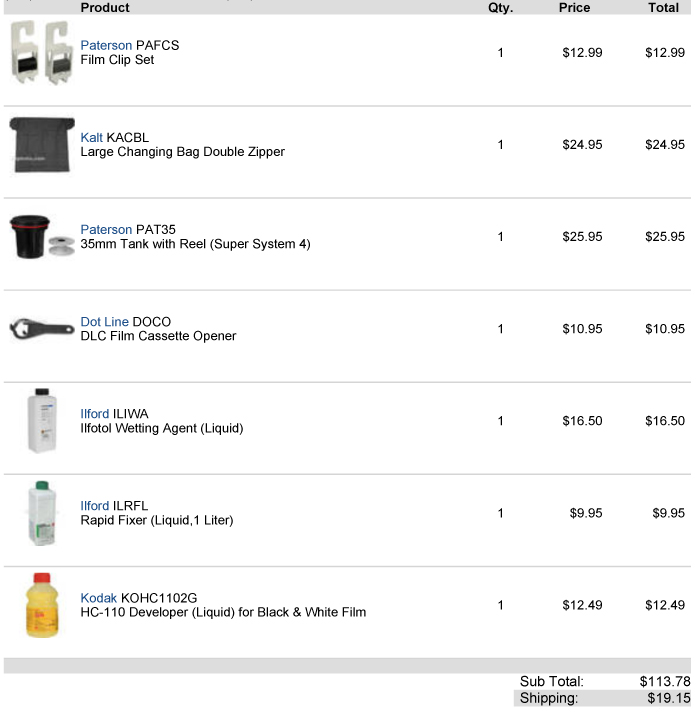
Mark graciously sent a copy of his bill to me to share with you:

_

*There is no advertising on this site, so I do derive no financial benefit by providing the link to B&H.

*Note: There is no advertising on this site, so I do not benefioviding the link to B&H… I’m just a very satisfied customer._


_

Total cost including shipping: under US$135!

These are very exciting times for Mark, and I hope for many of you reading this.

Thank you again Mark, for graciously sharing this information.

—Peter.

Advertising on Prosophos.com?

Q&A

A few months ago, the good folks at WordPress contacted me directly and informed me about their new WordAds* initiative.

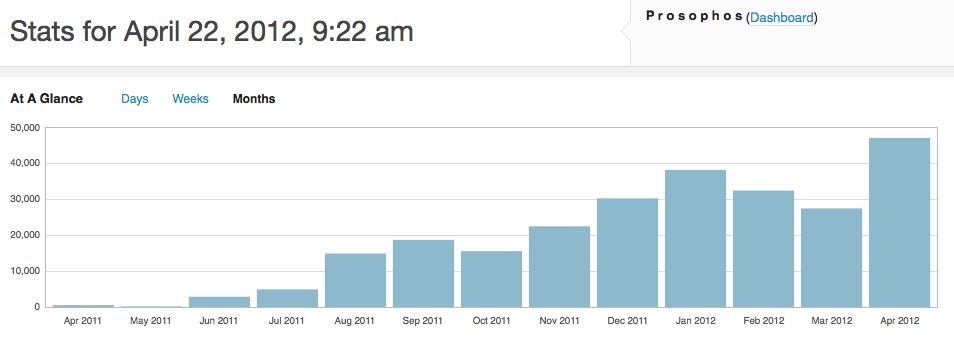
In short, this initiative would allow for advertising on my site and, in return, I would receive financial compensation (amount unknown).  My initial reaction was to be wary, as I don’t condone visual pollution of any sort, and I like the clean and simple look of this site.  However, as time has gone on, the site has drawn more and more viewers:

_

I have correspondingly invested more and more time running Prosophos.com, often spending several hours a day posting images, answering comments and individual private e-mail requests for help, writing articles and lens field reports, and honing the overall interface.

I’ve slowly realized that I can’t keep going at this pace, without somehow giving up more of my “real work” time.

I’m left with a couple of options:  I could focus on only posting images, and not respond to questions in the comments section or to private requests for help.  Or, I could give WordAds a chance.  Obviously, I very much enjoy writing and interacting with everybody who visits this site, so the first choice is — in my estimation — not really a choice at all.

So the decision has been made.  Starting soon — possibly next week — you may see advertisements on this site.  I’m told I can shut them down at any time.

We’ll see how it goes.

I hope you understand, and I would appreciate any comments on the matter.

Respectfully,

—Peter.

ADDENDUM (May 14, 2012):  I have held off introducing advertising for now, as doing so would require changing my site theme/interface, which is not something I’m prepared to do.  I’ll keep you posted as things develop…


________________________________

* if you don’t know about WordAds, you can read about it here and can fill out this form to be considered for approval.

Q&A: Bishop asks about shooting portraits with a 35mm lens.

Leica 35mm Summarit f/2.5, Leica 35mm Summilux ASPH FLE f/1.4, Q&A, Teaching point

“I am new to following your site…via your guest blog entry on Steve Hufff’s site and I wanted to say I enjoy your work very much.  The tones, the processing when in color and your subject matter are a joy.  I look forward to seeing more of your posts in the future.

A quick question for you though.  I noticed many of your portraits are shot with a 35mm lens.  I am wondering if you are cropping your resulting image?  I ask because your portraits are closer than what I am achieving with a 50mm without being in the face of my own children.  Not that I am a purist and don’t crop images but I try not too.  Appreciate your comments on this as you are able.

I should also add that I enjoy how you capture your children in the midst of their activities…not an easy thing to do I am sure but what a great result.

Thanks and I look forward to more of your work.  

Best regards — Bishop”

Hi Bishop,

Thank you so much for writing, and for the kind words!

In answer to your question, I don’t often crop when using a 35mm lens*, because if I did, I would lose the more interesting perspective I get with this FOV, vs. the 50mm. It’s true that one needs to be more careful with distortion when photographing people with a 35mm lens (and to some extent distortion is always there), but with practice you learn to minimize it and/or take advantage of it.

It took me some time to learn how to do this, because I was always a “50mm photographer”, but the rewards have been worth it.  Of course, I still shoot with a 50mm lens!

I hope I’ve been able to help, and thanks again for writing,

—Peter.

________________________________________

*In those of my 35mm images where people appear “closer” than what you’re able to achieve with your 50mm lens, Bishop, I have obviously cropped the image.  Having said that, I’m normally photographing people as close as possible.

Commenting on the commentary (a follow-up to my post on Steve Huff’s site).

Favourite, Inspiration, Q&A

_

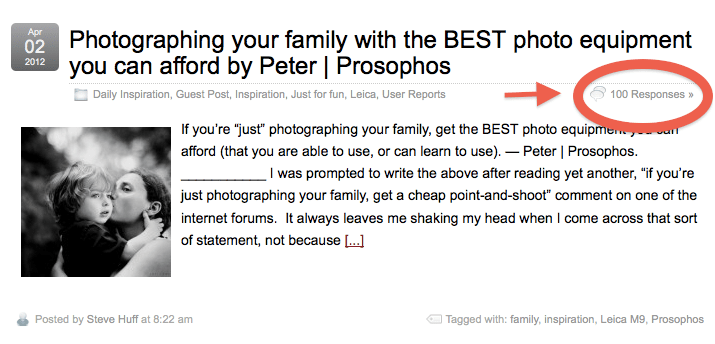
Two days ago, my “Photographing your family with the BEST photo equipment” article was featured on SteveHuffPhoto.com.

The piece generated much commentary, and I’ve read through all of it.  Almost all of it was overwhelmingly positive but, surprisingly, a few negative responses emerged.  I write “surprisingly” because I always choose my words very carefully and I know there wasn’t anything controversial or provocative in my post.

It was meant to be very positive, in fact.

But this is the internet age, where making a statement like “I like pizza” will generate a handful of negative responses.  Arguing with the responders is not productive, of course.

You know, I realized several years ago just how inconsequential all the frantic machinations of daily life can be, when we don’t take the time to appreciate each other.  The only important thing — the only enduring thing — when you strip away all the pretenses, is this:

_

“How we treat each other is the only thing that counts.”

_

So, instead of trying to respond to a few negative comments, I’d like to take the time to post a personal “thank you” — on this very site — to all of the wonderful people who got my post.  For their very eloquent comments (some critical, but at least constructive) I’d like to specifically thank these individuals:

_____________________________

Neil Buchan-Grant

Ashwin Rao

Duane Pandorf

Colin Steel

Photozopia

Jonny

Harry

Danniel Schwartzkopf

William Jusuf

Joanne Puyat

Travis

Robert T Wilson

Armanius

Leo

Duncan

Flamingjune1967

Denis

cidereye

Laugaut

Jack

Michael S.

Nacho Pello

Mark S

Peter Laaba

derekdj

Bryan Campbell

Paco

Guillaume

Andrew

Chrstine Lee

William Jones

Matus

Rick Alan

jim

David Young

Kelvin

Mo Han

Jason Howe

Richard ford

Dariel Palacol,

Dj0502

Joan

Andrew Ryle

Gauge Caudell

Orestis

John

des

Manny

Peter

Charlie

Marc Weisberg

Tyson Ng

c.d. embrey

Bianca

Felipe Méndez

Dan L.

Henk

Jun

Radar

Twitch

Enzo

David Young

Denis

John Driggers

Greg

dan

Chris Smith

Garazd Vahen

Jag Siva

Jacob

Steindid

Godfrey

______________________________

_

Last but not least, I want to thank Steve again for his generosity in allowing me to share my words and images on his wonderful site.

—Peter.

Q&A: Jonathan asks about my post-processing.

Inspiration, Q&A

_

Hi Peter

Really love your photos. I wonder if you would be willing to share some of your post production tips? I am sure most of the photos qualities come from your gear, but i wonder if I could produce something similar in my PP. (i.e. the dark rich colors and deep blacks)

Many thanks,

Jonathan
(sweden)


Hi Jonathan,

I really appreciate it when someone takes the time to write to me.

I’ve often been asked about my processing, and it’s always a difficult question to answer.  Partly because I process each photo individually, depending on the subject matter, lighting, and mood.  Partly because I’ve worked hard at developing my style and it’s very personal to me.

I wrote a few comments about it recently.  You can view them here (please see the comments section) and here.

I wish I could be of more help.  Maybe if you ever visit Toronto, we can go on a Shooting Session (or post-processing session) together…

Regards, and thank you once again,

—Peter.

Why I photograph wide open (Life as a dream).

2012, Inspiration, Leica 50mm Summilux ASPH f/1.4, Portrait, Q&A, Teaching point

_

↑Leica M9 and Leica 50mm Summilux @ f/1.4.

_

“Wide open shooting for me

is a sort of visual short-hand

to communicate life as a dream.”

_

For anyone familiar with my photographic work, it’s evident that I have a preference for shooting at wide open apertures.

There are plenty of reasons why I do this, but the main one is this:  the visual imprint of wide open shooting is one where some things are readily perceived, while others are only hinted at… which is an accurate representation of how we perceive the world.  And every single (fleeting) moment of life.

—Peter.


Q&A: Lucy asks about moving to film, and about the Leica 35 Summilux ASPH FLE.

Film, Leica 35mm Summilux ASPH FLE f/1.4, Leica 50mm Summilux ASPH f/1.4, Q&A

[I received this message from Lucy today and thought it was worth publishing her questions and my responses.  Please feel free to contribute an opinion, if you have something constructive to say…]

_

Hello Peter.

_
I enjoy your blog very much. Capturing precious moments with the camera is why I enjoy photography and so I do appreciate the photos you take. I feel guilty to ask about gear, I know this should not matter but you use lenses I am interested in and my decisions at the moment are about selling my M9 and investing in film and a scanner (and a lot of learning time) or going with another Leica lens and staying digital.

_
I have spent and lost a bit of money with leica lenses and my next choice is hopefully going to be a better one than others I have made.

_
I just sold my Summilux 50 asph and have now just have the M9 and 50 pre asph. It is ok but the focus is very stiff and I want to sell it and When I have sold it I can afford another lens, a 35mm will be be the most useful fov and it will have to be my only lens.  I found the 50 asph a little boring and I wonder how do you compare the 35 Lux fle with the 50 asph?..I think if the 35 if more interesting in it’s rendering I may just settle with the M9/35 combo and forget about setting up in film..My film camera choice is a Rolleiflex TLR, also of course a scanner and the learning curve of all that ..which could prove to be wonderful.

Sorry to prattle on, I admire your work and would value your opinion on the lens very much.

Many thanks
Lucy

Hello Lucy,

Thank you so much for your message and for your kind words – I’m so glad you identify with the “precious” moments depicted in my work, as it’s what I strive to capture and convey.

So many questions you’ve asked!  I’ll do my best to answer them, but I also invite any readers of this site to offer you an opinion too, as it’s always more fruitful to harness the knowledge of a community vs. a lone voice.

My chief piece of advice would be to “follow your heart”.  Seriously.

Anything else I write is just my personal view and it does not necessarily mean it will mesh with your current development or growth as an artist and photographer.  Intuitively, you probably already know what the answer is for you, but you also seem to be in need of a little direction because you’re contemplating very different paths.

Whether to opt for film or not is a very personal choice.  If you’re a methodical photographer who appreciates the “craft” of working with, processing, and scanning film, then by all means, go for the medium format Rolleiflex.  With that sort of a set-up you should be able to produce stunning results.  Weighed against this is the mounting difficulty in procuring and working with film… it really does seem to be disappearing from the public spotlight as a photographic medium, although I believe it will always be around in some form or other.

If you choose to stay with your M9, I’m not sure the stiff focus on your pre-asph 50 Summilux is reason enough to sell it, because that can be repaired.  But, further down in your message, you mention you’d rather go with a 35 FOV in which case selling the pre-asph 50 makes sense.

Finally, as for the rendering of the 35 Summilux ASPH FLE vs. the 50 Summilux ASPH, I too have gone on record as stating the 50 Summilux ASPH is an almost too “perfect” and extremely boring lens.  I can write forever about this, but you seem to have reached the same conclusion so I won’t “preach to the choir”, so to speak.  I will write that I’m currently using one and trying to like it.  Occasionally, it astounds me with what it produces, so it’s not like I’m incapable of appreciating it.

The 35 Summilux FLE is probably the best lens – technically speaking – I’ve ever used.  It produces what I would call “hyper real” results (incredible sharpness, micro-contrast, etc.) and is not as sterile in its rendering as compared to the 50 ‘lux ASPH.  In a way, the 35 FLE also is too “perfect” but somehow it manages to retain more character than it’s 50 ASPH sibling.

Although you didn’t ask, the lens that I think combines the best combination of technical excellence and interesting rendering is the discontinued 75 Summilux… but the 75mm focal length is not as versatile as a 35 or 50.

I hope this helps, Lucy, and I thank you once again very much for your kind words!

—Peter | Prosophos.

Thanks Dominic!

Inspiration, Q&A, Teaching point

Just finished a Practical 1-on-1 Teaching Session with Dominic this morning and had a great time.  As always, I tried to pass on some photographic pearls of wisdom — hope I succeeded. :)

Thanks Dominic, you are a gentleman and it was a pleasure meeting and photographing with you (I hope your planned solo shooting this afternoon was a success… please send some photos my way!).

Reminder:  if you’re interested in a practical, one-on-one photography teaching session, please have a look here, or contact me here.

—Peter.

You, the viewer.

Inspiration, Q&A, Teaching point

WordPress, which hosts this site for me, has recently added some functionality to their statistical summary pages.

Up until today, I knew that there were just over 1,000 visits to the site a day.  From the comments I receive here and via email, I had a sense of where some of the viewership was originating, but it was all a little vague.

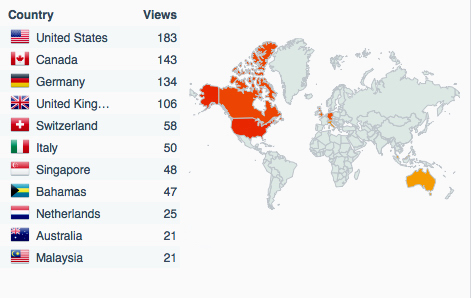
Well now the picture —so to speak — is clearer… and I’m a little bit surprised.  For example, here is a screen shot taken yesterday from my admin page showing the breakdown of visits:

↑Views on Thursday March 8, 2012, as of 8:30 pm.

The visits from the United States and Canada, and even the UK, are not so surprising, but Germany being in the top 3?  That was a pleasant surprise.  As was seeing the presence of Switzerland, Italy, Singapore, Bahamas, Netherlands, Australia, and Malaysia!

In fact, when I access the all-time viewership, I am quite amazed:

↑Distribution of all-time viewers (Total = 189,106) since April 25, 2011.

When I started this site, I knew I wanted to build a platform upon which I could share my images and thoughts to satisfy my creative needs.  I also wanted to establish a web “presence” so that I could build a client base for my photography.  What I didn’t realize at the time was how much contact I would have with people from all over the world… people who share the same passion for “seeing” and ultimately interpreting the world… all within the constraints of a humble still image.

That has been most gratifying.

—Peter.

Two Sunday mornings open in March for Practical Teaching.

2012, Inspiration, Q&A, Teaching point

If you’re a photography novice in the Toronto area and are interested in one-on-one Practical Photography – Teaching, I currently have two Sunday sessions available in March:

March 4 & 25 (morning sessions)

The two hour sessions are tailored to your needs and are meant to be a non-intimidating way of getting out there and taking photos!

If you want to learn more about my teaching sessions, please see here.

Thanks,

—Peter.

Q and A: Voigtländer Nokton 40/1.4 vs. 35/1.2?

2012, Inspiration, Q&A, Teaching point, Voigtländer 35mm f/1.2 Nokton, Voigtländer 40mm f/1.4 Nokton

I received this via email this week and — because this is a question I’m often asked — I thought I would feature this as a Q&A post:

_

I’ve become a regular follower of your blog and I really love it! Respect to the fact that you manage to post a good and interesting photo each day. I try do to the same and sometimes it is hard to do so.

I’ve a question however. I work with a M8 and M9 and do weddings and other documentary work, sometimes portraits, lots of editiorial work. Since I left my 5D2 at home, life began to be fun again (I mean photographically). However, sometimes I miss my 12.500 iso and 50/1.2 lens (which wasn’t sharp at all wide open btw).
I’m thinking of buying a low-light lens to use in case the light is really bad. My fastest lenses are the 35 and 50 summicron and I’m thinking about the 35/1.2 and the 40/1.4. The 50 is too quirky I think.
The difference between the two is ‘only’ a half stop, but the difference between 1/45th and 1/60th can be crucial. On the other hand, I won’t take the 35 as a daily to go lens in my bag, while the 40 will fit in very easily. The price difference is also quit big, but not that big a deal. It’s still cheap in Leica-terms.
It wouldn’t be a problem to take the 35 to important shoots as an ‘in-case’ lense, but would that half stop make the difference?

Could you give me any advice in which of these two to choose?  I hope I don’t bother you too much with this these questions.

kind regards,

Joeri

_

Hi Joeri,

Thanks for the nice note!

The Voigtländer 35/1.2 (either Version 1 or 2) is the technically better lens with a desirable mix of both modern sharpness and classic rendering.  It does not focus shift, so it won’t frustrate your focusing attempts.  And it’s maximum f/1.2 aperture, as compared to other 35 lenses with a maximum aperture of f/1.4, does make a difference — not so much with respect to the extra light collected, but more in the ability to isolate subjects and create a nice “3D” effect (see an example image here).  If you don’t mind the size, it’s an all-around “better” lens than the Nokton 40/1.4.

The Nokton 40/1.4 on the other hand, is just so darn small and versatile, behaving in many ways like both a 35 and a 50 lens, but it’s the technically “inferior” lens:  not as sharp wide open, flares more, has been known to focus shift.

In the end, both lenses are capable of producing great images, so it really depends on what you value most – small size and versatility (40/1.4), or technical excellence (35/1.2).

It seems from your question that you already know the pros and cons of each lens, so it’s really up to personal preference.

Hope that helps, and thanks again for the nice note!

[If you are looking for more detailed information on both these lenses, please see my previous user reports:  Voigtländer Nokton 40mm f/1.4 and Voigtländer Nokton 35mm f/1.2]

—Peter.

Q&A: What are apertures and f-numbers? [for novices]

2012, Inspiration, Konica Hexanon 60mm f/1.2, Leica 75mm Summilux (Canada 🇨🇦) f/1.4, Q&A, Teaching point

[Note: This post is intended for novice, and not experienced, photographers.]
____________________________________

In photography, the aperture is the adjustable opening of a lens that determines the amount of light entering through it and onto a camera’s sensor, be it digital or film.  If the aperture is large, a large amount of light will pass through the lens and enter the camera; if the aperture is small, a small amount of light will enter the camera.

Simple, right?  But, it gets a little confusing…

The problem with using the entrance aperture size to communicate a lens’ light transmitting ability is the physical reality that a longer lens will require a larger aperture to achieve the same level of light transmission as a shorter lens.  In other words, if “x” is the amount of light we wish to reach a camera’s sensor, a 75mm lens will require a bigger “hole” (aperture) at the entrance than a 50mm lens to achieve “x”.

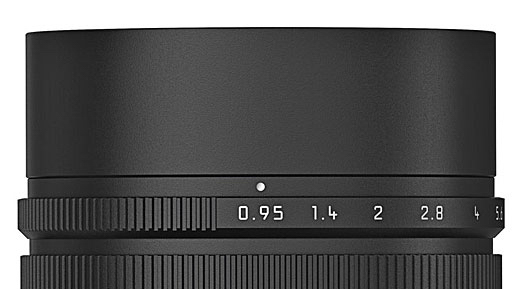
To avoid confusion, and to standardize notation across all lens types, f-numbers — instead of actual aperture sizes — are used to communicate the light-transmitting ability of all lenses.   An f-number (also known as an f-stop, or focal ratio) is defined as the focal length of a lens divided by the aperture diameter.

You’ll usually see f-numbers labelled on lenses as a sequence of fractions:

f/1, f/1.4, f/2, f/2.8, f/4, f/5.6, f/8, f/11, f/16, f/22, etc.

The important thing to remember is that because the f-number is a fraction, the smaller the denominator, the greater the light transmission.

(please click on the image to view LARGER)

Thus, when considering light transmission, f/1 > f/1.4 > f/2 > f/2.8 > f/4, etc.

In fact, for every step to the left in the sequence above, twice as much light is being transmitted as the preceding step.  Thus, f/1 allows for twice as much light to hit the sensor as f/1.4, and f/1.4 allows for twice as much light as f/2, etc.

Incidentally, lenses that are able to achieve maximum f-numbers of f/1, f/1.4, or f/2 (or even f/2.8) are often loosely referred to as “fast” lenses because they allow photographers, for a given amount of light, to shoot at faster shutter speeds than so-called “slower” lenses (exactly twice as fast for each step up in the f-number ladder).

It follows from the above, then, that large aperture/f-number lenses are useful in low-light situations:

↑Leica M9 and Konica Hexanon 60mm @ f/1.2.

The other main use for large aperture/f-number lenses is to achieve subject isolation.*

Thus a lens of a given focal length set to f/1.4 (for example) will create a greater background blur than when set to f/4.:

↑Leica M9 and Leica 75mm Summilux @ f/1.4

_
↑Leica M9 and Leica 75mm Summilux @ f/4.

_

I hope you found this useful,

—Peter.

______________________________________________

*The other way to achieve subject isolation is to shoot with a longer focal length.

Q and A: Voigtländer Nokton 40mm f/1.4.

2012, Q&A, Teaching point, Voigtländer 40mm f/1.4 Nokton

This arrived via email this morning and I was about to respond as I usually do, but then realized, I often get this question, so why not turn my response into a post that will hopefully be of help to other readers?


Hi. I read your review for the The Voigtländer Nokton 40mm f/1.4. and found it very helpful. I have this lens with a Leica M9 and don’t seem to be getting the results you pictured. Did you alter your M9 shots in Lightroom or do you have the lens detection set a specific way in the M9 for the The Voigtländer Nokton 40mm f/1.4? My shots tend to come out overexposed when I use it open to 1.4. Any suggestions would be appreciated. Thanks and keep up the good work. Your photos and reviews are great.

– Adam.

First of all, thank you Adam for your very kind words.

Now, regarding your questions…  I post-process all of my files in Apple’s Aperture and then do my final colour tweaking in Nikon’s Capture NX2.  On the M9, I have lens detection set to “auto”, but I do not code any of my uncoded lenses, so for lenses like the Nokton 40/1.4 the camera isn’t recognizing anything and is therefore NOT making any adjustments.  For focal lengths longer than 35mm, there really is no need for coding anyway, unless you’re hoping to correct for vignetting or are interested in generating focal length EXIF data.

Finally, I always shoot in manual mode (controlling for aperture and shutter speed) and often manually set the ISO.   I never rely on the camera’s metering.  I’ve done this with ALL of my cameras, including Nikon, Canon, Sigma, etc., because no camera – not matter how sophisticated – truly understands what your “mind’s eye” is seeing when you attempt to create an image, and it’s better that you take full control of all the variables.

I hope this helps.

Thanks again for writing Adam, and Happy New Year,

—Peter.