
Here’s a second image, taken a little earlier from the first (and cropped).
The lighting is different, and I’ve processed it differently too.
I realize I’m comparing apples to oranges, but I’m curious on your thoughts as I work through these D800E/Otus files.
—Peter.
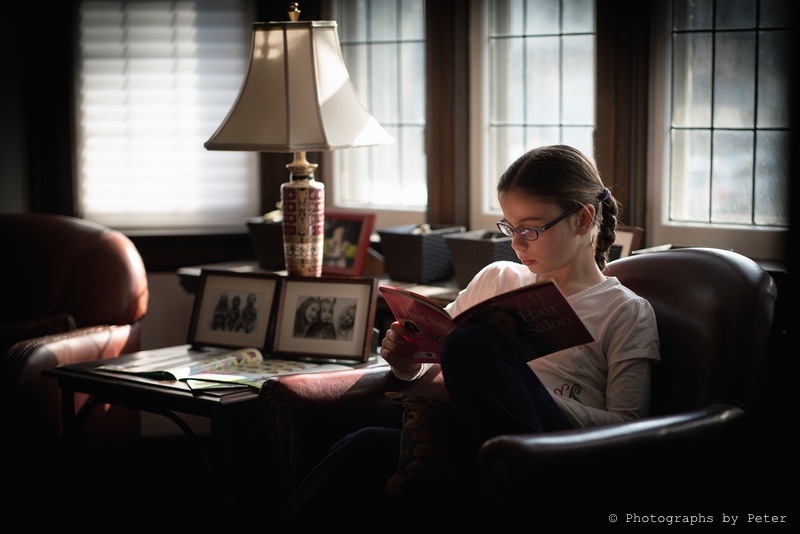
↑Nikon D800E and Zeiss Otus 55mm @ f/1.4.
 Prosophos
Peter, to me this second trial looks less good. The first one might not look perfect regarding skin tone but the image in total looks very much alive as if you are on the scene. The second one looks rather dull and lifeless, more like a picture. And the increased vignette also makes it less natural and a bit overdone. But I could be wrong entirely.
I like the first one best. The light hitting her face is more pleasing too me. BTW, and I’m being serious, I wish you had a M240 with comparable lens at your side and you did some side-by-side comparisons with it and the D800E. Even though I think the D800E overall would win, I think you would find both images being very similar.
gage
The responses are surprising me so far. I liked the first image better as an image, but I believe the processing here is more successful — more natural.
Gage, I believe the M240 files would behave similarly. In processing the D800E files, I’m encountering the same issues I had with the M240 — argggghhh that darn CMOS effect 😦
—Peter.
And Herb, I agree with your criticism re: the vignette…
i must say, with all respect that i do prefer the rendering and the colors of your m9 photos.
So far, I cannot disagree with you.
Like the other guys I like the first one better. More to do with perspective and composition.
Given the light on the face is even brighter (than image 1) and the vignetting seems to accentuate the contrast between shadow and highlights a little too much. It seems highlights may be blown a little a bit like the MM can do? What ISO did you use on this one? How do you find slightly underexposing and bringing back up in post? 1/2 stop. I wonder if this would have any effect on the skin tones.
Given colours as we see them, are a consequence of reflection of light this sensor seems to handle that light in a warmer manner (like the M240) than the M9. Have you tried playing with the Temp (Kelvin) gauge in camera? Might help but also trialling in post out of camera may be the way to go. Given CMOS are more advanced with high ISO capability they are designed to deal with light sensitivity in an advanced way. However it also effects the temperature and therefore colours, making them warmer.
I’d put money on, if you rented a D4/Df for the weekend you’d find the output in colours and temp more pleasing and be more in line with the M9.
This could all be jibber from me but just throwing out some thoughts :-)!
Long live the CCD sensor!
In processing the D800E files, I’m encountering the same issues I had with the M240, which is not surprising, given they are both CMOS-based cameras.
I’ve tried the sort of things you are suggesting (underexposing, etc.). I normally underexpose, in fact. However, when I do it aggressively with CCD and then bring up the shadows, the file holds up. When I do it with CMOS, the file falls apart.
I have only one comment Peter – Alex still has an M9-P available.
Ouch… that stings Kevin. You cut me bad 🙂 …
I personally prefer your processing in the second image, much more natural looking. I prefer the composition of the first though.
For a time I had an M9, M240 and Sony A7R, and did quite a bit of testing with all three with my 50 Lux. What I found is that the A7R resolved the most detail, however lacked a crispness and micro contrast that the M9 had. There also appeared to be more depth to the M9 photos, and a more ‘true to life’ rendering. The M240 sat right in the middle of the two. It had slightly more micro contrast than the A7R in my opinion, but not as good as the M9. It seemed to me like it had traded some high ISO performance for an overall less noise reduced image, but still didn’t have the qualities of the CCD sensor. The white balance and skin tones on the M240 was the worst of the three, although the firmware update did improve this a lot.
I really wanted to prove to myself that the M240 was just as good as the M9, as I loved it in every other way. When I say just as good, I mean in the qualities that I am looking for in my images. They are all great cameras and can make stunning images, this is purely my preference.
When it comes to high ISO, the order is reversed. I rarely go above 800 ISO though, so this was not too big of a concern for me. I also found the advantage was somewhat eradicated, but the faster shutter speed I needed to get a really sharp image on the A7R handheld.
Perhaps rushing to buy a d50 would be interesting n super economical . It’s a ccd sensor n you can still autofocus
I really dislike auto focus… the last time I used it was in 2007.
They hv improved much since. But autofocus lens could nvr match pure manual lens in the solid feel . Manual lens on Olympus is godsent, image stability comes free
So now everybody hopefully understands why I have been so adamant in my enthusiasm for the CCD sensor.
The problem is, no one is going to be making a camera with one in it going forward…
What is interesting is, even the medium format manufacturers are beginning the move to CMOS. I just wonder if anyone is doing a comparison of the Phase CCD versus CMOS at base ISO. Given a few of the comments I’ve read on this thread, the extra resolution of the D800 is not a solution to regain “the look” of the CCD.
I find this thread very intriguing. The esthetic of the way you shoot people is difficult and challenging to achieve for most professionals, much less “wanna-be” professionals. Being great at capturing facial expressions at that proper moment is not easy. Then you add compositional elements, lighting et.al, it is a most challenging field of shooting. You have a unique talent in that area. Part of “your esthetic” is the expressions of your subjects and the environment they are in. The other vital part of “your esthetic” the way the files look technically is becoming marginalized in the process of looking for a solution that might not have an answer with the CMOS.
I love shooting with my M240 alongside my M9, but they are very different in the look and it is something I cannot fake with software.
Chris D wrote:
“I love shooting with my M240 alongside my M9, but they are very different in the look and it is something I cannot fake with software.”
Exactly. So now what? Beats me…
Thanks for the nice comments Chris.
—Peter.
Take the electronics out of the technical esthetic. Go back to shooting b/w film with your older M’s. Get your hands on some Agfa Rodinol and develop at 1:75 dilution for about 30 minutes as a starting point. You’ll find a level of acutance in your negs that would cut like a scalpel. I could never go back to film; don’t have the patience and my clients won’t wait. I don’t believe you’re in that situation and you can take the time. Might want to consider that option at least until the chemistry & emulsions disappear.
I’ve largely gone back to film for my B&W work (the Leica M3 and Mamiya RZ67) because I never found a digital solution that looked good (whether it was a Nikon, Leica M9, or even Leica Monochrom). For colour, I still rely on digital and I intermittently have clients requesting formal portraits in colour. Also, for event shooting I tend to rely on digital too…
I prefer you images from the M9. Please do not take offense, the comments here are made in what I hope is the spirit of this discussion forum. (I am biased maybe because I have an M9 and a Monochrom.) I agree with several of your regulars above. I.E. The image quality from a Df or D4 is nicer than the D800E. It doesn’t bite your eye. It’s the nicest CMOS image qualty I’ve seen so far. ( I’m not convinced about the Otus yet, either.) Granted the Df/.D4 doesn’t have the resolution either. There’s something about a CCD originated image that I prefer, a certain almost indefinable but clearly understood magic; a bit like the sound from one of older Wooden bodied koetsu cartridges. There is a natural and organic quality, a sort of magic to the sound.
I know I,m going off topic but for me at least the analogy is good.
Leica piss me off a lot. Crap electronics, can’t shoot a blast, crap screen, Questionable longevity of the digitals, (my M9 feels like it is wearing out) They take a WEEK to write the buffer. But Ahhhh!!!! The Image quality. Isn’t that why we do it, put up with them…
Also, am I seeing a different kind of picture from you with Nikon? When I switched to an M9 from a Big Eos 4 years ago (it was getting too heavy) I found the Leica Viewfinder/ rangefinder, on second thoughts the whole Leica thing, small light, fixed focal length etc completely refreshing. I started taking a different kind of picture. Using an SLR is just not the same.
Hi John, I do not take offense at all. Thank you for your honesty.
Mood and feelings still hold and great. Shadow transition in this picture is not really impressive. But my experience on D800e tells me that it just need some post works, like try Capture One.
The inability of CMOS to hold shadow detail is one of my main frustrations with with system.
Peter,
I like the second processing more, it’s got natural warm light and natural highlights in the window. I think you should just shoot, and forget about the CMOS vs. CCD thing. Your talent and adaptation to the new system will make up for most medium differences.
R.
Peter. I have been reading your blog for many years and am drawn to it because you capture emotion and the ‘defining’ moment like very few others on the internet. Your processing is unique and always beautiful. BUT your timing and your technical ‘mise en scene’ is exquisite – your emotional truth and hence its validity makes your photography an art that continues to always be relevant.
I like the first but prefer the second because to me it shows the book entrancing and captivating. The vignetting emphasizes the great solitude and wonderment of disappearing into a book.
I agree that the photo may have ‘more’ with the CCD (hence I keep my D200 – although I shoot my 800E with Noct as much as possible) however when anyone looks at your photography, your art is what draws the eye.
I know that you will maximise the D800E and Otus, as you will with the next system in your quest to satiate the uneasiness BUT I think your dissatisfaction (electronic, reliability, colour, usability, tones etc – there will always be SOMETHING!) makes GREAT art!
Thank you for this great blog!
JJ, that’s an interesting observation. My dissatisfaction is very frustrating, but yes, it pushes me to improve. However, there are days when I just want to toss out all of my equipment and forget about photography for a while.
Oh boy, do I ever know THAT feeling.
Just to go in a different direction for a moment the 1st image is timeless, I have 2 daughters and have in my time nailed a couple of images of them I am sure we all have of our kids. As faciniating as the tech side is, in 5 years looking back at that photo I am sure the only thing you will seeing is your daughter. That being said this is a intriguing subject and I am leaning a lot from the comments.
Yes and no Pi. I go back to my older images all the time and I think: I wish I knew then what I know now. However, I still appreciate the images, so I can’t argue with what you’re saying.
Curiously, I never second guess my film images, because the “processing”, to my eye, is always as it should be….
I like the first one with the light rendering on her, the hair sparkling at the edge. however, I prefer the 2nd one on how it handles the windows, the chairs and the lamp. But none of them gives me the look when you shoot with M9 + 50 Lux. My personal guess is it related to the Otus/ 800E CMOS sensor rendering the highlights. It is too clinic and lack of micro contrast.
I think you may be focussing too much on the superficial aesthetic qualities of the image, the “perfume” as HCB called it. Both images are fine.
I remember reading his “perfume” comment and thinking I was guilty of that… but I couldn’t (and still) can’t help myself. As nice as a photo may be emotionally, I can’t resist looking at an image and seeing how it could have been technically improved…
To my eye & emotional sense, the 2nd pic is best. We now not only see the title of the book, but also her hair and forward-draped braid as a subtle question mark re the book’s title and content. I love the attitude of cozy, warm comfort suggested by the position of her legs, crossed white feet in white stockings, and the wisp of light across the top of her head and right kneecap. The warmth of the reflected light upon her face simply adds to the sense of cozy, warm comfort. (I have been able to cool down overly warm skin tones better in Aperture 3.5 than in LightRoom.)
I just wonder…If you never alluded to jumping ship on the Leica, posted these shots and said to the group, “your critique please”, how this thread would have tracked.