Kids just know how to laugh.
(please click on both images to view)

↑ Leica M9 and Leica Tele-Elmar 135mm f/4 @ f/5.6.

↑ Leica M9 and Leica 75mm Summilux @ f/1.4.

Kids just know how to laugh.
(please click on both images to view)
↑ Leica M9 and Leica Tele-Elmar 135mm f/4 @ f/5.6.
↑ Leica M9 and Leica 75mm Summilux @ f/1.4.
Sometimes even a posed shot can be quite revealing. I guess it speaks of how easily kids can live in the moment.
This image was chosen as a Leica Fotografie International (LFI) Master Shot.
(please click on image below)

Leica 75mm Summilux f/1.4 @ f1/.4.
Natalie – a portrait.
Taken yesterday.
(please click on the image below)

Leica M9 and Leica 75mm Summilux @ f/1.4.
If you examine my photos, you’ll notice a dominant diagonal line running through many of them. I’ve sort of learned to make images this way automatically, after years of photographing.
Why is a strong diagonal important?
I don’t know the academic answer but I know the simple one: in many cases, photos look better with it than without it.
A strong diagonal connects a photo from the top to the bottom and, in doing so, serves to visually point (much like an arrow) the viewer’s eye from one end to the other and, at the same time, ties the image together. It also serves to “fill” the frame. Finally, it acts as a balance or scale where you can divide the remaining visual elements equally between the two halves on either side of the line. These last two points are, in actuality, addressing and solving problems related to composition.
But enough talk – let’s look at some images.
The 3 images below feature simple structures that form an easily identifiable strong diagonal element:
(please click on any of the images below)

↑Leica M9 and Leica 75mm Summilux @ f/1.4.

↑Leica M9 and Voigtländer Nokton 35mm @ f/1.2.

↑Leica M9 and Leica 28mm Summicron @ f/2.
In this next image the subject is the beach and the strong diagonal is its shoreline:
(please click on the image below)

↑Leica M9 and Zeiss ZM 21mm @ f/2.8.
In each of the above photos, I could have composed differently, but the result would be less pleasing to the eye. How strong is the effect?
Well, take a look at this shot:
(please click on the image below)

↑Leica M9 and Leica 75mm Summarit @ f/2.5.
I had originally taken this photo as a portrait with the subject placed a little off to the side (one of the “rules” of taking portraits is to not centre the person, but that’s another discussion). However, the strong diagonal of the field line kept interfering with my original composition and crop, and the eye kept falling short of the corner of the frame – the look was simply inharmonious. When I cropped the photo so that the white line was allowed to span the image from one corner to the other, the composition became more pleasing, even though I was now violating one of the rules of portraiture.
Such is the strength of the dominant diagonal that our brains are actually willing to give up reality in favour of a more pleasing composition . Here’s an example:
(please click on the image below)

↑Leica MP and Leica 35mm Summicron @ f/4.
We all know that a tower doesn’t jut out of the earth sideways like the CN Tower appears to be doing above, but the photo is made more pleasing to the eye because of it. On a side note, the chosen composition also emphasizes the sheer height of this structure because it somewhat disorients us, and gives us a sense of what it must feel like to stand at the base of the tower.
Here is another example:
(please click on the image below)
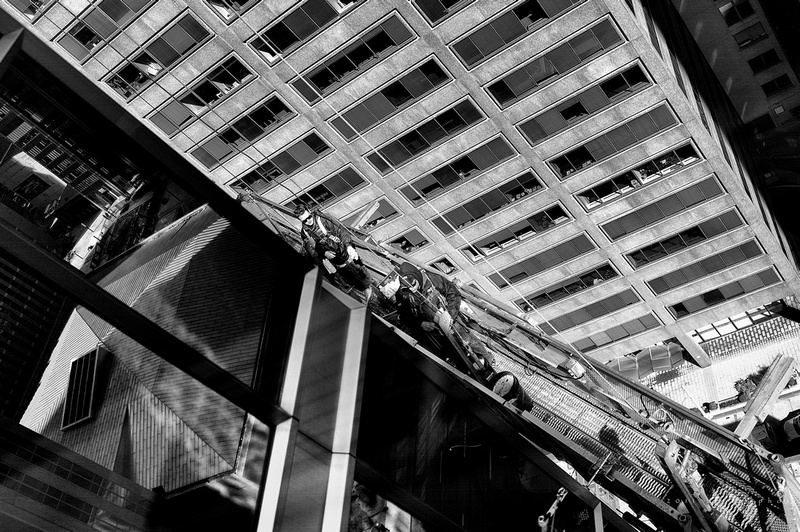
↑Leica M9 and Leica 35mm Summarit @ f/2.5.
Once again, the image elements (the buildings) have been tilted so that the window washer platform forms a strong diagonal. The tilting here is also successful because of the sense of vertigo it adds to the image which, by the way, is named Vertigo.
Finally, here is what I would consider a very successful use of a diagonal:
(please click on the image below)

↑Nikon D3 and Nikon 24mm AF-D @ f/2.8.
In the image above, the diagonal is the barrier separating the (Niagara) Falls from the girl. What’s more, this division has resulted in a harmonious composition in that the Falls and the face are equally prominent on either side, and the image is therefore “balanced”. Finally, on an artistic note, the strands of the girl’s hair over her face mirror the linear strands of water behind her, which is immensely pleasing to the eye. I cannot pretend to have planned it this way, but my choice of composition resulted in a happy accident.
I hope the above discussion on strong diagonals was helpful.
The 10 minute ferry ride to Toronto’s Centre Island takes us away from the skyscrapers and hustle-and-bustle of the mainland. On this evening, we were blessed with a gentle breeze and a flooding of gorgeous light, allowing for a classic portrait.
(please click on the image below)
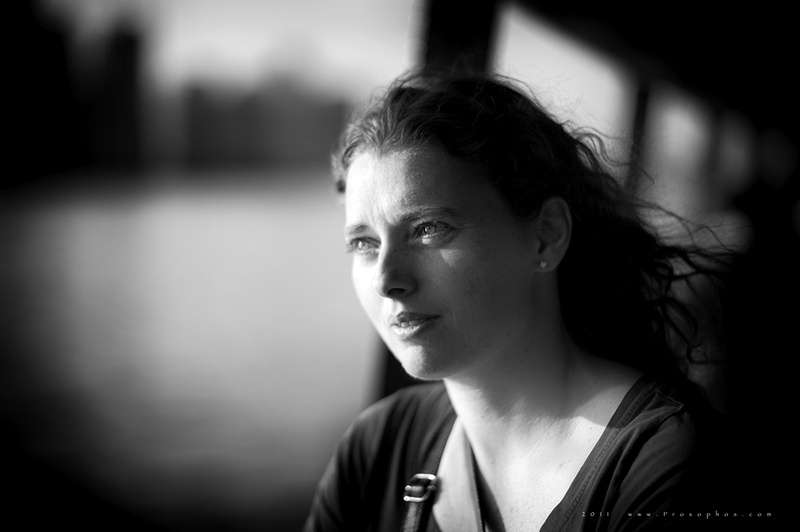
Leica M9 and Leica 75mm Summilux @ f/1.4 with a 3 stop ND filter.
Harsh light washes out colours and details, and creates blown highlights and deep shadows. The latter two are unflattering to faces, so I try to avoid shooting in bright midday light when photographing people.
Sometimes though, the moment inspires and emotion wins over technical perfection.
[Photography Pearl: An emotionally appealing, but technically flawed, photograph will always trump a boring, but technically perfect one. If an image connects with the viewer, it has succeeded.]
(please click on the images below)

↑”Springtime” (Leica 50mm Summicron @ f/2). [This image was chosen as a Leica Fotografie International (LFI) Master Shot].

↑”Mother and daughter” (Leica 75mm Summilux @ f/1.4 with a 3 stop ND filter).

↑”The contortion of play” (Leica 75mm Summilux @ f/1.4 with a 3 stop ND filter).

↑”Not homeless, just tired” (Konica Hexanon 60mm @ f/1.2).
All images taken with a Leica M9.
 Prosophos