(please click on the image to view)

↑Leica M9 and Leica 135mm Tele-Elmar f/4 @ f/5.6.

(please click on the image to view)
↑Leica M9 and Leica 135mm Tele-Elmar f/4 @ f/5.6.
Playing in somebody’s life, near you.
(please click on the image to view)

↑Leica M9 and Leica 135mm Tele-Elmar f/4 @ f/5.6.
Double, double toil and trouble;
Fire burn, and caldron bubble.—William Shakespeare, Macbeth.
(please click on the image to view)

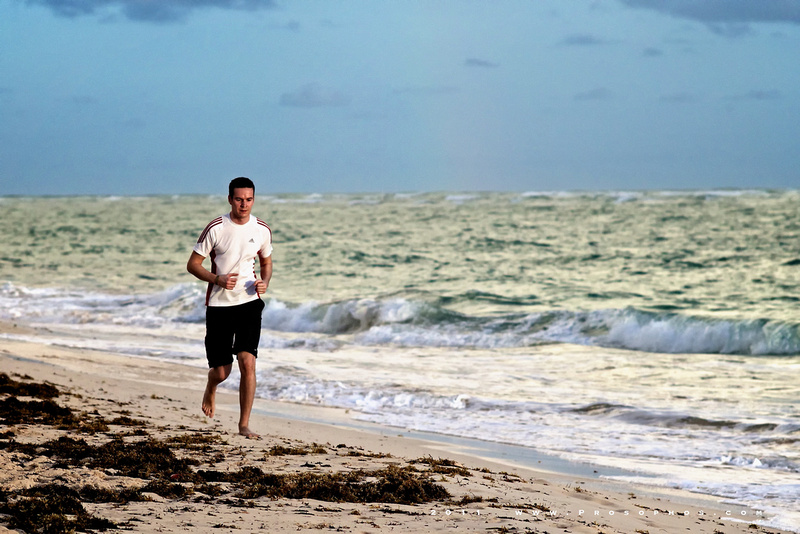
↑Leica M9 and Leica Tele-Elmar 135mm f/4 @ f/5.6.
Illuminated by a glorious sunrise.
Even @ f/5.6, this 1966 Tele-Elmar 135mm is capable of producing some seriously shallow depth of field… the runner looks like he’s a cut-out figure pasted onto the scene.
By the way, I’ve tried using the Tele-Elmar at its widest aperture of f/4, but the rendering there isn’t as sharp.
This is definitely a daylight lens, but a great daylight lens.
Also, I’ve been pleasantly surprised to find that — despite the longish 135mm focal length — the Tele-Elmar has proven easier to focus accurately than many of my mid-range lenses.
(please click on the image to view)
↑Leica M9 and Leica Tele-Elmar 135mm f/4 @ f/5.6.
(please click on the image to view)

↑Leica M9 and Leica Tele-Elmar 135mm f/4 @ f/5.6.
Three different images, taken at three different times of the day, using three different lenses.
(please click on any of the images below)

↑ Leica M9 and Leica Tele-Elmar 135mm f/4 @ f/5.6.

↑ Leica M9 and Leica 50mm Summicron @ f/2.

↑ Leica M9 and Konica Hexanon 60mm @ f/1.2.
Kids just know how to laugh.
(please click on both images to view)

↑ Leica M9 and Leica Tele-Elmar 135mm f/4 @ f/5.6.

↑ Leica M9 and Leica 75mm Summilux @ f/1.4.
I previously shot some images for Eunice (see here) at her swim school and was asked yesterday to create a cover image for her about-to-be revamped brochure. The front cover is to feature Eunice engaged in her greatest passion – teaching.
(please click on both of the images below)


↑Leica M9 and Konica Hexanon 60mm f/1.2 @ f4.
Here is another image that, although not intended for the cover, may be used as part of other promotional material:
(please click on the image below)

↑Leica M9 and Leica Tele-Elmar 135mm f/4 @ f/5.6.
As an aside, I’ve taken other images while at the school:

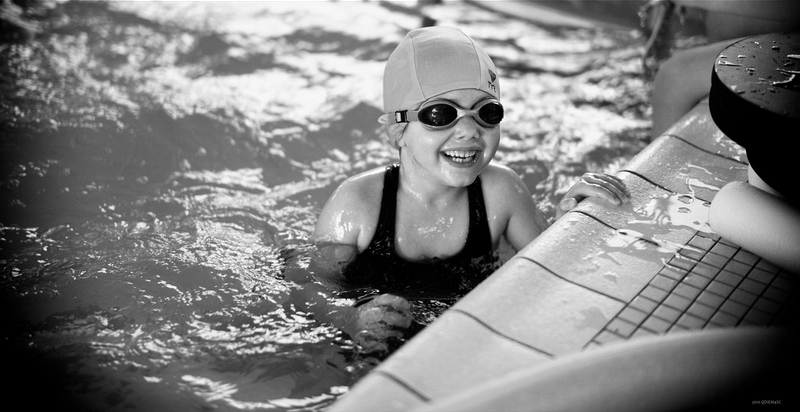

The above images were taken with the Leica M9, the Leica 50mm Summilux ASPH f/1.4 @ f/1.4 (first two) and the Konica Hexanon 60mm f/1.2 @ f/1.2 (third).
An impromptu street shoot yesterday…
(please click on the images below to view)


Both images taken with the Leica M9 and Leica Tele-Elmar 135mm f/4 @ f/5.6.

(Photo Source: L Camera LeicaWiki)
–
The Leitz (Leica) Tele-Elmar 135mm f/4 is a lens I’ve been seeking for a while.
When I moved away from DSLRs, I sometimes missed having a longish focal length for certain applications, like photographing sports (where shooting from a distance is often a reality). Telephoto lenses are also surprisingly useful for landscape photography, and for portraiture too.
However, 135mm represents a long focal length for a Leica M camera, because accurate manual focusing in this range can be tricky unless both camera and lens are in perfect calibration.
Knowing this, I nonetheless set out to find the venerable “T-E 135”.
The Tele-Elmar 135mm f/4 was manufactured from 1965 to 1990 before it was updated, first cosmetically, and then to the current Apo-Telyt 135mm f/3.4 form in 1998.
Why was I looking for the older model?
The current Apo-Telyt 135 approaches a cost of US$3300 (as of July, 2011), whereas a T-E 135 can be found for as little as $500, and the performance difference is said to be negligible! In other words, the older model represents one of the last true bargains of Leica optics. The other things in favour of the T-E 135 are its small size and light weight – these are qualities I value dearly.
Well, I finally secured an excellent condition Tele-Elmar 135mm f/4, manufactured near the beginning of its production cycle, in 1966. This makes my copy a 45 yr old lens!
Fortunately, manual focusing with the T-E 135 has been easy and accurate. The lens is a little soft at its widest aperture (f/4), but is quite sharp beyond that, with excellent contrast. Given the apertures involved, this lens will most likely be used in outdoor settings where plenty of light is to be found.
Funny enough, my first use of the T-E 135 occurred at an indoor pool, as I couldn’t wait to try it! The lack of light necessitated shooting at a relatively slow shutter speed of 1/125 sec and a high ISO of 2000. Here is the end result:
(please click on the image below)
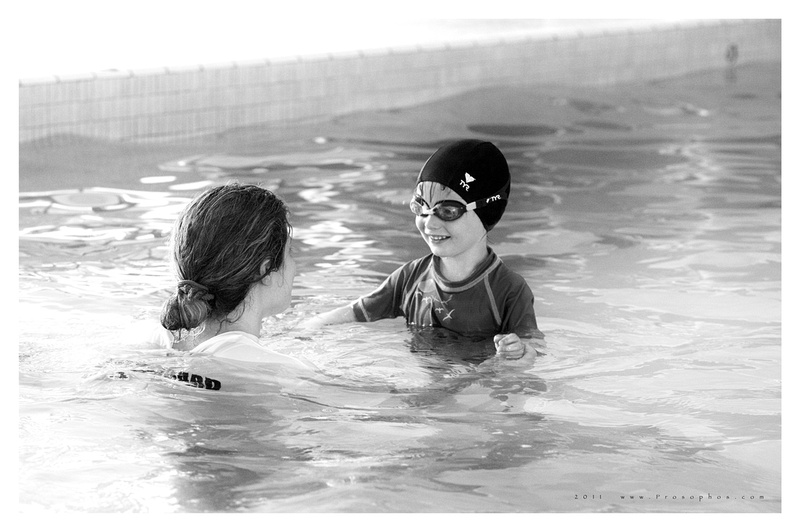
↑Leica M9 and Leica 1966 Tele-Elmar 135mm f/4 @ f/5.6.
_____________________________
Please show your appreciation for this article!
If you’ve been helped by this article, or any of my other articles, please consider making a contribution to help me run Prosophos.com. Whether it’s $1, $5, or $10… it all helps.

This site is a labour of love, but any help I receive will help me devote more time to running it.
Thanks,
—Peter.
 Prosophos
