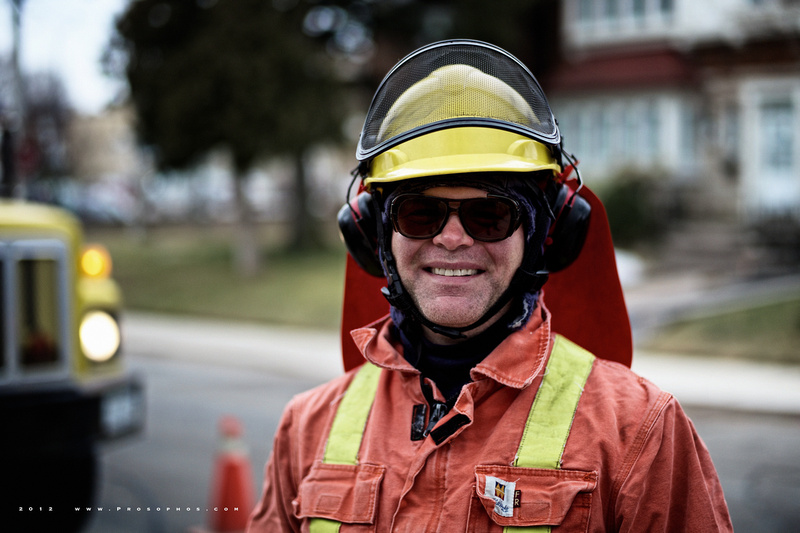
No, this was not captured on film.
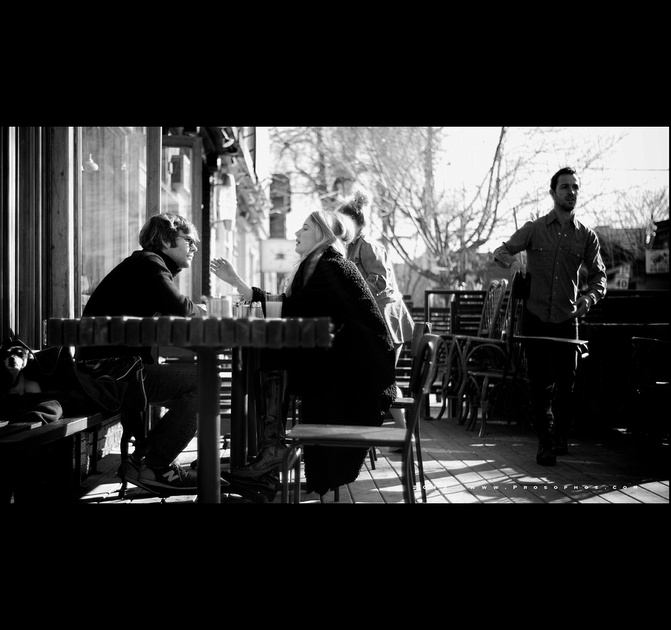
This was taken with an M8. Its files are capable of some of the most beautiful B&W conversions of any digital camera.
(please click on the image to view)
↑Leica M8 and Voigtländer Nokton 40mm @ f/1.4.
As I previously posted, I recently acquired a Leica Noctilux f/1.0 and added it to the stable of lenses I normally use.
Now, I am not a lens tester by any stretch of the imagination – I don’t photograph test charts, or brick walls; I don’t place my camera on a lab bench with a tripod taking repeated measurements.
But, like all disciplined photographers, I do carefully observe how each of my lenses behave under different shooting circumstances. I pay particular attention to each lens’ strengths and weaknesses in environments in which I regularly find myself, and – finally – look for the general character of the image output. That’s what I’m most interested in.
By doing this, I have conceptually set aside certain lenses for daylight use, for low-light, for action, for situations where cold-hard details are required, for situations where soft and dreamy portraits are my priority, for scenes in which “interesting” bokeh is desired, for scenes where neutral and smooth bokeh is preferred, etc. Each lens has a particular flavour that potentially lends itself to a given situation.
So, that being said, I took out my new-used Noctilux f/1.0 for a walk – to start acquainting myself with it.
Normally on this site, I only post photos that have some emotional significance to me. However, I thought some of the the sample images from my “test” walk would be of general interest.
Please note that all of these images were shot at f/1.0 – the aperture in which I’m most interested. A neutral density filter was used to overcome the brightness of shooting at f/1 in daylight.
The first thing I was looking for was general sharpness. Lens sharpness isn’t everything, but it is important. It’s the one thing you can’t add to a photo during post-processing, if the photo is blurry to begin with (whereas you can always take a sharp photo and make it blurry).
When I write sharpness, I’m referring to central image sharpness and not sharpness across the field. As a (mainly) portrait shooter, I really don’t care if the corners of an image are blurry – in fact that’s a positive thing for me. Landscape shooters, of course, would care.
The first image is of a Monarch butterfly I encountered:
(please click on any of the images below)
↑Leica M9 and Leica f/1.0 Noctilux @ f/1.0.
The sharpness seems pretty good (the focus was on the butterfly, of course). The bokeh looks pretty good too – smooth but not too smooth for my taste.
Let’s look at the 100% crop. The sharpness holds up but we also see something commonly encountered with fast lenses shot at their widest apertures: purple fringing.
↑Leica M9 and Leica f/1.0 Noctilux @ f/1.0 (100% crop).
Purple fringing tends to occur in high contrast transition points, typically on the edge of dark structures – in this case the edge of the butterfly wing – against bright backgrounds. In actuality, purple fringing is an example of longitudinal chromatic aberration (forget the technical stuff, just know when you’re likely to see it, as I’ve illustrated above).
Let’s look at another image.
I next encountered this scene of a man sitting on a park bench and focused on him:
(please click on any of the images below)
↑Leica M9 and Leica f/1.0 Noctilux @ f/1.0.
And here is the 100% crop:
↑Leica M9 and Leica f/1.0 Noctilux @ f/1.0 (100% crop).
Once again, pretty darn good considering this was shot at f/1.0 in harsh daylight! It’s not as sharp as the (newer) Noctilux f/0.95 ASPH is at f/1.0, but the “old” Noctilux’s ability to capture details is mighty impressive. I would go further to say that I appreciate the character of this lens at f/1.0 more than of the newest ASPH Noctilux. It’s hard to explain, but this old Noctilux seems to create images where the in-focus elements are simultaneously sharp and soft… Again, perfect for portraits.
OK, enough of sharpness and image crops.
The other thing I noticed while shooting was that at f/1.0 this Noctilux vignettes. Here is an image where the vignette has been exaggerated by adding contrast to the image as a whole (i.e., I did not add a vignette, but by adding contrast to the entire image, the vignetting that was naturally produced by the lens was exaggerated):
(please click on the image below)
↑Leica M9 and Leica f/1.0 Noctilux @ f/1.0.
Why am I evaluating vignetting in an image that I’ve already post-processed? Well, as I wrote above, I’m not scientifically evaluating but I’m examining this lens under the conditions in which I work. In the native file, I already see the vignetting but, by adding contrast to it, the vignetting is emphasized.
Again, vignetting may be a negative thing, depending on your style of photography, but I appreciate it in the case of portraiture, where the darkened borders help to “bring out” the central subject.
Speaking of “bringing out” the subject, I’ll include two more images taken during my walk that I believe highlight the subject isolation abilities of this lens, when shot at f/1.0:
(please click on any of the images below)
↑Leica M9 and Leica f/1.0 Noctilux @ f/1.0.
What do I mean by subject isolation? In each of the above images, the in-focus elements seem to “pop-out” of the image; some refer to this as the “3D” effect. Whatever you call it, this look is secondary to the shallow depth of field conferred by shooting at f/1.0. At f/1.0, there is only a razor-thin plane where things are going to be in-focus; the rest of the scene will out-of-focus. This is one of the qualities people covet when they seek out a lens like the Noctilux and why they shoot at f/1.0 – even in daylight.
I could write more (about bokeh, flare resistance, etc.) but this discussion is already proving to be lengthy so ‘ll end it here for now.
OK, I lied… here is one more 100% crop, of the Balloon Walk image above:
(please click on the image below)
↑Leica M9 and Leica f/1.0 Noctilux @ f/1.0 (100% crop).
You can actually read the Happy Birthday text on the balloons; as I wrote above, the in-focus elements in the image are simultaneously sharp and soft – I really appreciate this.
Thanks for taking the time to read this.
If you wish to view more of my images taken with this lens, as I keep shooting with it, please click on the link here.
_____________________________
Please show your appreciation for this article!
If you’ve been helped by this article, or any of my other articles, please consider making a contribution to help me run Prosophos.com. Whether it’s $1, $5, or $10… it all helps.
This site is a labour of love, but any help I receive will help me devote more time to running it.
Thanks,
—Peter.
Two distinct moments captured seconds apart, but requiring two different treatments.
(please click on each image to view)
Both images taken with the Leica M9 and Leica 50mm Noctilux @ f/1.
[I just acquired this Noctilux and will be working it into the rotation of daily photos, though not every day, of course. At some point, I’ll summarize my thoughts on it.]
She was self-conscious about her new glasses. She hates getting attention – any attention, whether good or bad. So, the glasses are bad.
She was even upset that we took her for an eye check-up, to verify what we suspected – that she wasn’t seeing properly.
But, she looked beautiful and I wanted to get a shot of her on her first day with them. However, life being life, offered just this moment.
It’s morning. We’re all headed for school.
All three are about to run. In a matter of seconds, C will trip, fall, and skin her knee. So this is the shot that survives for posterity.
Her injury, however, distracted her from her glasses.
Life, being life.
(please click on the image to view)
↑Leica M9 and Leica 75mm Summilux @ f/1.4.
I know it too well. She’s wondering if she’s ever going to get her coffee.
The lighting was tricky here… mixed natural and incandescent. On the other hand, the blinds shielded against the harshest of the outside light and things balanced nicely.
(please click on the image to view)
↑Leica M9 and Konica Hexanon 60mm @ f/1.2.
I love how the girl furthest back, by adjusting her hair the moment the shutter was released, has filled out the composition: her posture creates an inverted triangle that fits like a puzzle piece between the triangles formed by the postures of the two figures closest to us. It is difficult to explain so here is a visual of what I mean:
She did get her coffee, eventually.
This shot is unsuccessful.
The scene is from the lobby of the Royal York Hotel in Toronto where an interesting vantage point is afforded by the arrangement of the floors and spiral staircases – it sets up an almost Escher-like effect on the brain.
(please click on the image to view)
↑Leica M9 and Leica 50mm Summicron @ f/2.
My goal was to capture the bustling movement of people, on each level, including the connecting staircase. The first strike against success was the lens – I had a 50mm, and I needed a 35mm. Consequently, the frame is tilted in order to try to “fit” more of the scene into the field of view (this somewhat contributes to the general visual disorientation so it’s not such a bad thing). The second – and more fatal – strike was that, despite the constant flow of human traffic, there was never any satisfactory simultaneous distribution of people amongst the levels. Despite waiting for it to happen, it never materialized.
Still, I kept this shot as a token for my efforts. I do like the fact that the man in mid-step (bottom right) has spotted me, despite being two levels beneath me.
I found this photo button this morning after taking the kids to school. It was a gift from my grade 6 school teacher, one fine spring day, a long time ago.
I remember the occasion vividly, for no good reason. Surprisingly, it has survived in the bottom of drawers, in bags, during moves, in times of illness and in times of death.
I can’t tell you what camera or lens was used. It really doesn’t matter.
(please click on the image to view)
A scene from their lives during a Sunday outing. Conveniently – though somewhat unfortunately – framed by the top of a trash bin.
Whether either of them – many years from now – will remember this particular moment, is unknown.
(please click on the image to view)
↑Leica M9 and Voigtländer Nokton 40mm @ f/1.4.