Leica T.

Q&A, Teaching point

Leica T - Photographs by Peter

↑Photo courtesy Leica.


No, I wasn’t given the newly-released Leica T Type 701 to review.  And no, I haven’t tried it.

But I’m getting emails asking me about it, so I’ll make a few comments.

The sensor is excellent (they’re using a tried-and-tested sensor), and the new lenses (only two have been announced so far) will perform in the typical Leica fashion — wonderfully.  And, of course, they released an M adapter for M lenses.  Nice.

I’m too biased towards optical viewfinders and larger sensors to be tempted by it.

However, I’m quite impressed with Leica‘s execution on this release.  They got the marketing right, and the design (minimalistic — read: excellent).  They even got the right reviewers on board, and were careful to educate them on the product beforehand.

Most impressively, they out-Appled Apple with the interface.

I like what they’ve done.

—Peter.


Eyes – Test Shot Portrait (Mamiya Tilt/Shift).

2014, Favourite, Film, Inspiration, Kodak Tri-X 400, Mamiya RZ 180mm F/4.5 Short Barrel, Mamiya RZ67 Professional Pro II, Mamiya Tilt/Shift Adapter, Portrait, Q&A, Scanner - Plustek 120, Teaching point

My first portrait using the Mamiya 180mm f/4.5 Short Barrel lens with the Mamiya Tilt/Shift Adapter.

I really should be supporting this heavy and unwieldy gear with a tripod, but I’ve avoided tripods all my life (ahhh the undisciplined life of a candid photographer).

Not bad though.  I see great potential with this set-up.

—Peter.

Eyes - Mamiya Tilt:Shift Adapter Test Shot

Springtime in Toronto, Part 2.

Film, Inspiration, Kodak Tri-X 400, Mamiya RZ 110mm F/2.8, Mamiya RZ67 Professional Pro II, Portrait, Q&A, Scanner - Plustek 120, Teaching point

You have to love this city and its weather 😉 .

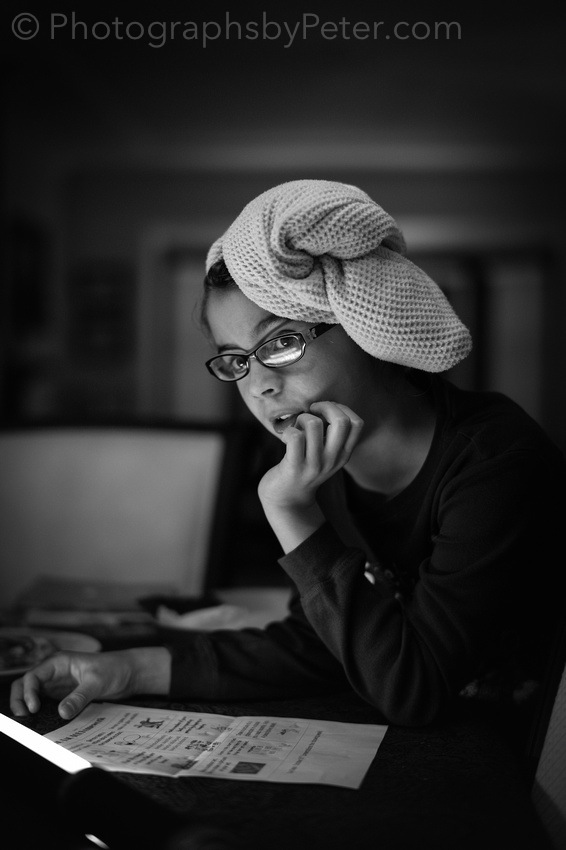
This image was taken using the Mamiya 110/2.8 at its near focus limit; even at f/4 (the aperture used for this shot), the depth of field is quite thin — perhaps too thin for this portrait, since only the near eye is in focus.

Still, I like it.

The look of the Tri-X film and the bigger 6 x 7 “sensor” of medium format is quite remarkable.  Notice the true-to-life rendering of his face, texture of his hat, etc.  Currently, high-end 35mm digital cameras may be able to out-resolve this antiquated gear (at least using the scanner I’m using), but they cannot duplicate the look of this image.

—Peter.

Springtime in Toronto, Part 2

Giving Leica Credit.

Inspiration, Q&A, Teaching point

Leica.

Last week’s experience with new gear made me appreciate something all over again:  the joy of shooting with a rangefinder.

I’ve written about this previously, but it doesn’t hurt to be taught old lessons again.

Many people view the Leica rangefinder and its mechanical coincident focusing mechanism as antiquated.  Yet, I’ve chosen this type of camera (starting with the M8) for almost 100% of my photography for the last 7 years.  For me, and many others, there is no better example of an unobtrusive and high quality image-capable camera.

Recently, another camera company has been celebrated for manufacturing smaller-than-DSLR “full frame” bodies, yet it is noteworthy that Leica accomplished this back 2009 with the M9.  Moreover, to this day, Leica is the only company that (mostly) understands the ergonomics of a proper camera and the importance of an optical viewfinder.

The modern Leica M camera carries forward design principles that have been retained, honed, and perfected over many decades.  Quite literally, there is no competition in the current camera landscape.

On a final note…

Although I have been famously critical of a sensor decision Leica made with the M240 (though I’m learning to live with it), I have no problem giving credit where credit is due, so:

Thank you Leica, for the M.

—Peter.