

↑Leica M9 and Leica 50mm Summilux ASPH @ f/1.4.
–
I’m pleased with this image… the light, the mood.
And — curiously — her profile mirrors the contours of the lighthouse:
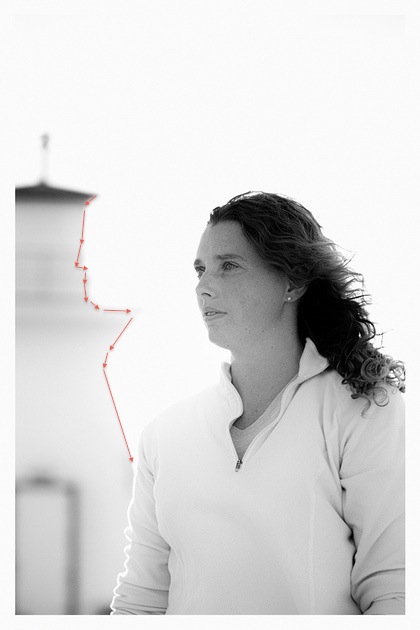
I hadn’t noticed it until my wife pointed it out.
Admittedly, our brains are always seeking to make order of the world around us, but the two main elements in this image — photographically speaking —complete each other. This sort of harmony ultimately resonates with the viewer, whether they know it or not.
—Peter.
 Prosophos
Hello Peter … Did you know that there is something different about your post-al delivery this morning… A “new”, less interesting, picture-less screen between the icon in Mail and the usual blog page… Perhaps I’m no being clear.
Re the light of the picture… Am I correct in saying that you had to open up the lens and / or increase compensation in order to have the face lit, and that consequently the left half of the picture is somewhat blown out… In other words, you made the compromise you had to make???
If you had moved your position, could there have been less blow out, or have you achieved effect you wished to achieve?
John
Dear John,
In answer to your question, this was a heavily back-lit scene, and there were NO compromises made.
As I’ve stated previously, I ALWAYS expose the light for the person… her face is the MOST important part of this image… the background can be blown away to Kingdom Come for all I care. Seriously. Even so, you can still appreciate the faint outline of the lighthouse.
And as I taught you at the Leca Akademie workshop, my goal when presenting my images is to convey the notion of “life as a dream”. The ethereal, unhinged, unanchored nature of the background helps do that. Think of it as a conscious choice (all the elements in my images presented on this website are carefully considered), as opposed to a technical flaw. And so, being a matter of taste, you – or anybody else – are free to disagree, and that’s OK (I’m not saying you disagree… just making a point).
Finally, as for moving my position… I wouldn’t think of it. The composition is most pleasing in its current configuration.
Hope that helps,
Peter.
Should have noted… Parallelism noted and appreciated.
John
My reaction the absolute instant the image opened on my iMac screen was “oh my god is that gorgeous”. I would never have noticed the outline in a million years, but it’s almost as if she cast a positive light shadow, an anti-shadow if you will, onto the structure.
I’m reading a very interesting book about (in part anyway) how sensitive the person with extensive experience in certain fields can be to patterns or anomalies in patterns they’ve experienced before. Many times it’ll present as an instinctive feel of right (or wrong) without a conscious recognition that could name it or say why. It is, the author postulates the origin of “gut feelings”. As you say, it’s a fitting together, an ordering, but he suggests (based on neuroscience research) that it actually happens chemically in the body/mind interface. Perhaps one of the things one acquires over the course of tens of thousands of images in the pursuit of mastery (I’ve oh so far to go) is the instinct to do what you did here in recording the echo unconsciously while so carefully planning out everything else.
Anyhow the image is a stunner and it’s very cool that your wife saw it first.
Dear Greg,
What a wonderfully insightful post… thank you.
Re: sensitivity to patterns or anomalies — stated another way: “pattern recognition”… I really do believe that after numerous attempts at mastering a skill — any skill — we become hardwired on a neurochemical level to achieve said skill, literally without thought. It happens all the time… sometimes (while engaged in a skill) the very second we consciously think about what we are doing is the moment we fail.
Back to photography… many times, I capture an image and then, after the fact, think about what appealed to me in the first place… what compelled me to click the shutter.
As for my wife recognizing the “anti-shadow” in this image first… she often sees things before I have… or, at least, before I’ve fully explained them to myself.
Thank you again for your very helpful comments.
Peter.